All Features on Every Plan. No Lock-In.

Constant Contact vs Klaviyo

A side-by-side comparison for teams choosing between Constant Contact and Klaviyo.

Last updated: December 16, 2025

Screenshot
vs
Screenshot

Quick Overview

Simple digital marketing suite vs data-driven personalization

The biggest difference between Constant Contact and Klaviyo is what they optimize for: Constant Contact is built to simplify day-to-day digital marketing from a single, easy-to-use platform, while Klaviyo prioritizes customer-data-driven personalization that adapts messaging to what people do and buy. If you need a straightforward way to create campaigns quickly, Constant Contact leans into that. If your strategy depends on tailoring outreach from rich customer behavior, Klaviyo leans harder into that foundation.

That tradeoff exists because Constant Contact’s positioning centers on helping small businesses “simplify and amplify” digital marketing with accessible tooling across channels, whereas Klaviyo’s product bets are anchored in a built-in customer data platform that unifies customer information into profiles and powers segmentation and personalized messaging. In practice, Constant Contact’s breadth aims to reduce complexity for running common marketing motions, while Klaviyo’s data-centric design is meant to make targeting and lifecycle messaging more precise as your customer signals grow.

What’s at stake is how your marketing stack behaves as you scale: whether you’re primarily managing campaigns through a general-purpose workflow versus orchestrating lifecycle messaging around a continuously updating customer dataset. This difference will shape how far you can push automation depth, cross-channel coordination, and personalization—and how much operational discipline you’ll need around data inputs, segmentation strategy, and ongoing optimization.

Quick Comparison

At a Glance

Category Constant Contact Klaviyo
Best for Small businesses and nonprofits Ecommerce marketing teams
Core strength Email templates and list management Customer data platform profiles
Automation depth Welcome and drip campaigns Behavior-triggered flows with splits
Pricing model Contacts and email send caps Contacts and email send caps
Learning curve Simple campaign setup Short learning curve

Vendor Snapshot

Company Snapshot

Background data gathered from our market research (founding year, HQ, team size, specialties, etc.).

Constant Contact

Visit website
C
30+ years operating Team 1001-5000
Founded
1995
HQ
Waltham, MA, USA
Team
1001-5000
Industry
Digital Marketing Platform For Small Businesses

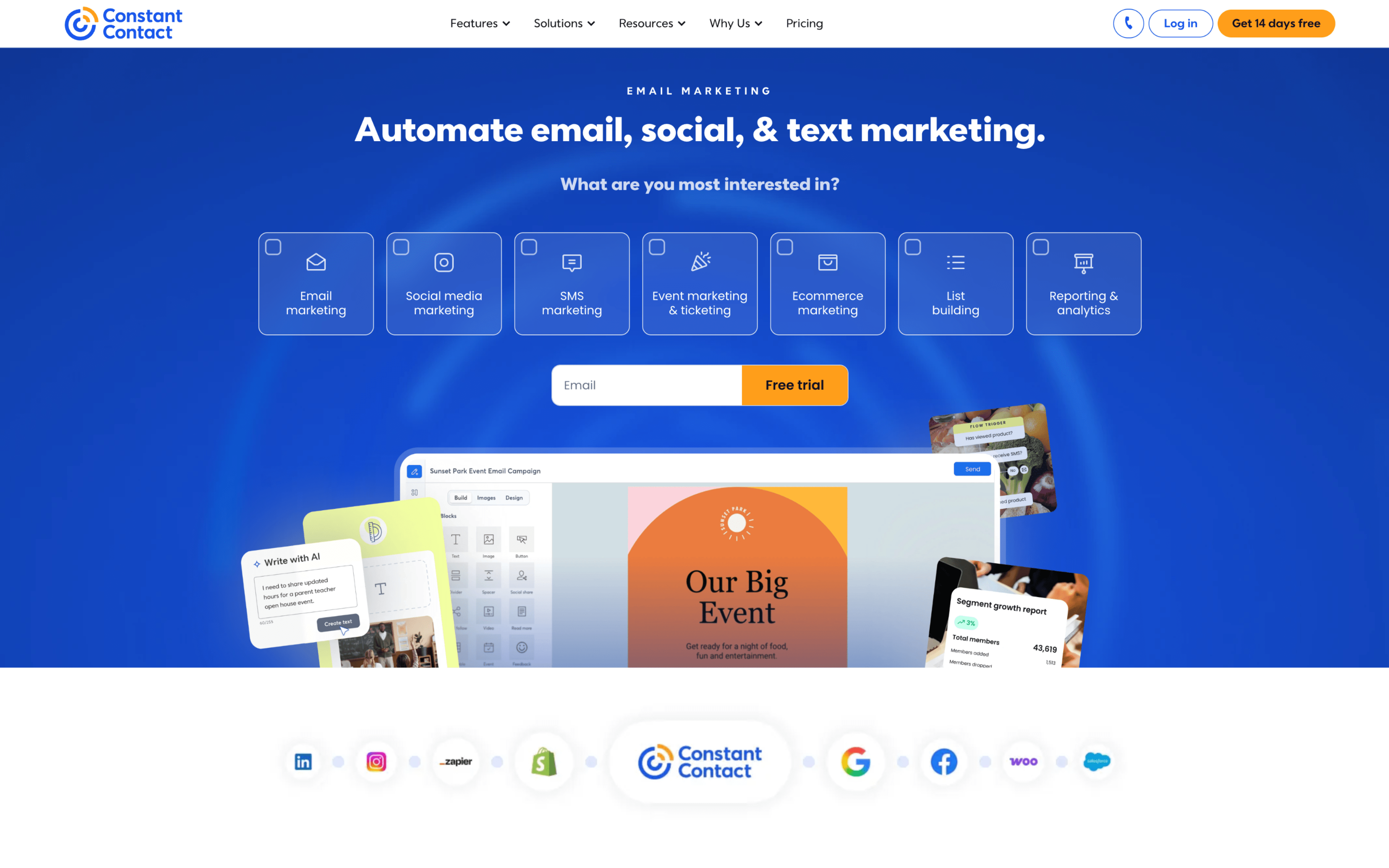
Constant Contact delivers digital marketing tools for small businesses to help drive sales, grow customer bases, and engage audiences. What started as email marketing has expanded into a broader digital marketing solution including list growth, social media, ecommerce, automation, events, surveys, and SMS.

Specialties

Analytics Contact Management Coupons CRM Customer Engagement E-Commerce Marketing Email Automation Email Design
K
13+ years operating Team 1001-5000
Founded
2012
HQ
Boston, Massachusetts, USA
Team
1001-5000
Industry
B2C CRM

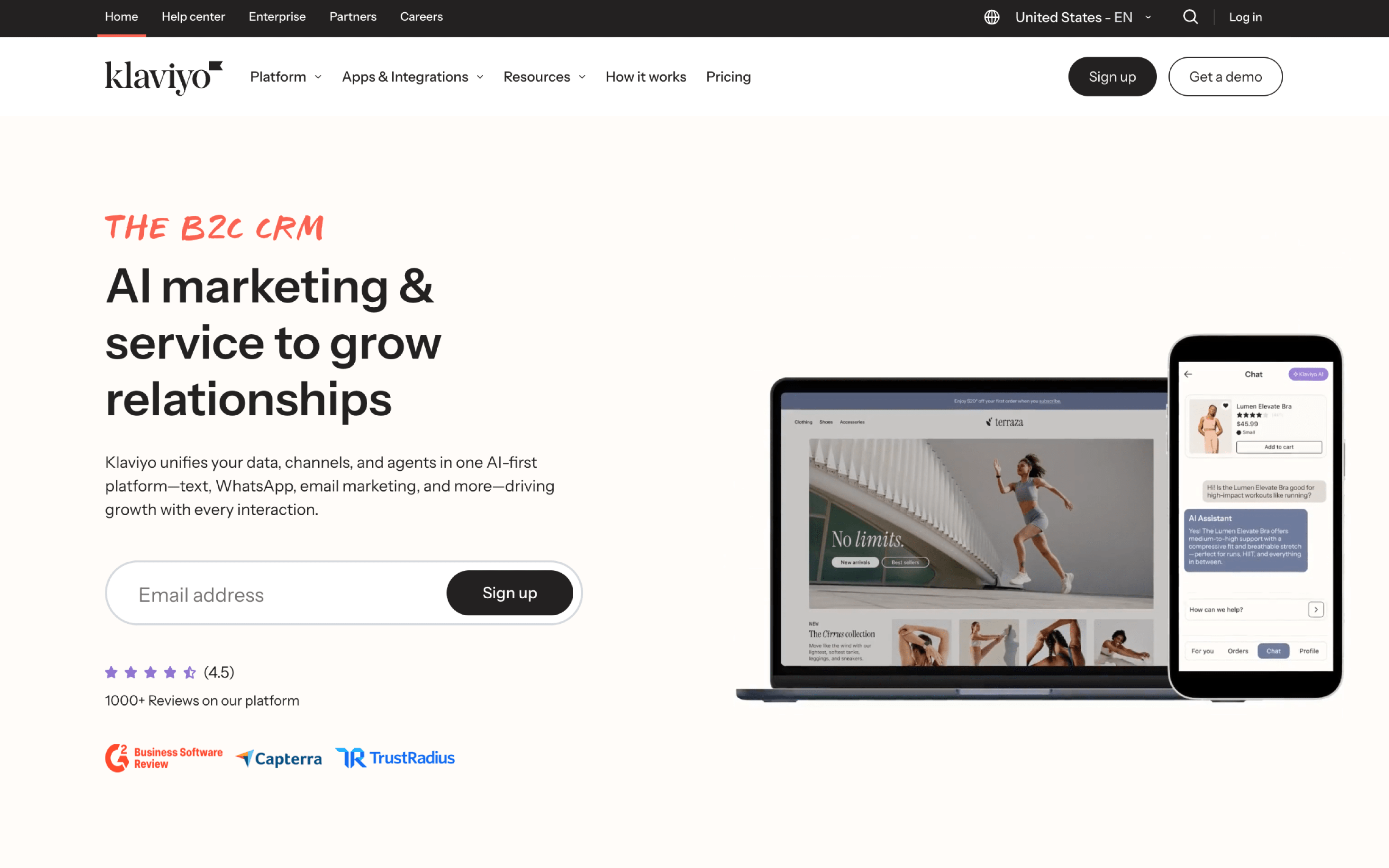
Klaviyo is a B2C CRM powered by a built-in data platform and AI, combining marketing automation, analytics, and customer service into one unified solution. It helps brands use customer data to deliver personalized 1:1 experiences at scale and drive revenue growth.

Why These Platforms Feel So Different

Constant Contact originated in the mid-1990s around making email outreach practical for smaller organizations. Klaviyo started in 2012 as a customer database to make brand-owned customer data usable. Those starting points pushed one toward reliable email execution, and the other toward capturing and operationalizing events.

Because Constant Contact began as email marketing, it prioritizes deliverability safeguards and permission-based sending practices. This leads to tighter controls around list quality, since bad lists can affect shared sending reputation. One concrete example is its compliance posture around consent, unsubscribe handling, and ongoing monitoring of complaints and engagement.

Because Klaviyo was built to solve the customer data problem, it prioritizes unifying behavior and transaction data into persistent customer profiles. This leads to greater emphasis on data volume, retention, and real-time processing, which adds operational and implementation complexity. One concrete example is its platform narrative of capturing “every click, purchase, and interaction” and keeping collected data in Klaviyo without expiration.

These origin choices created different default priorities that show up later as product tradeoffs. The next sections make those consequences visible when you compare how each platform behaves in real workflows.

Key Takeaways

Key Differences

Constant Contact and Klaviyo differ across core dimensions like audience focus, automation depth, data model, integrations, reporting, and scaling approach.

Market focus

General SMB vs ecommerce-first

Constant Contact targets broad small-business marketing, while Klaviyo is built primarily for ecommerce and lifecycle retention.

Automation model

Basic sequences vs event-driven flows

Constant Contact emphasizes simpler autoresponders, while Klaviyo centers on behavior-triggered, branching flows tied to customer actions.

Data model

List-based vs unified profiles

Constant Contact relies more on contact lists, while Klaviyo uses unified customer profiles updated from site and purchase activity.

Integrations

Broad apps vs store-native sync

Constant Contact supports many common business tools, while Klaviyo prioritizes deep, real-time ecommerce platform integrations.

Reporting

Engagement metrics vs revenue attribution

Constant Contact focuses on email engagement reporting, while Klaviyo emphasizes revenue tracking and performance across campaigns and flows.

Workflow complexity

Quick setup vs advanced segmentation

Constant Contact is oriented to fast campaign creation, while Klaviyo is designed for granular segmentation and scalable program complexity.

Feature Comparison

Feature-by-feature comparison

Comparison of core messaging, automation, list growth, analytics, and adjacent marketing capabilities.

Email editor and templates

Email creation tools, templates, and basic editing workflow.

Constant Contact

Drag-and-drop email editor with templates and AI writing assistance.

Klaviyo

No-code email builder with pre-built templates and dynamic content blocks.

Automation flows

Workflow builder for triggered and multi-step customer messaging.

Constant Contact

Automations for welcome, birthday, drip campaigns, and conditional paths on higher tiers.

Klaviyo

Flows with conditional logic and real-time behavior triggers for lifecycle messaging.

Segmentation

Audience targeting using profile, engagement, and behavioral criteria.

Constant Contact

Segmentation based on behavior and engagement with custom segments on higher tiers.

Klaviyo

Advanced segmentation using real-time behavioral and predictive data attributes.

SMS marketing

Text messaging campaigns and automation capabilities.

Constant Contact

SMS marketing included on Premium with monthly text message allotment.

Klaviyo

SMS and MMS with automation, segmentation, and unified data.

Sign-up forms and list building

Tools to capture subscribers and grow contact lists.

Constant Contact

Sign-up forms and landing pages for contact capture.

Klaviyo

Web form builder for pop-up, fly-out, and embedded forms.

Landing pages

Standalone pages for lead capture and campaign conversion.

Constant Contact

Landing pages available for list growth and contact capture.

Klaviyo

A/B testing

Experimentation tools to compare campaign variants.

Constant Contact

Subject line A/B testing available for email marketing.

Klaviyo

A/B testing with AI winner selection for email optimization.

Reporting and analytics

Performance dashboards, reporting, and engagement metrics.

Constant Contact

Analytics for opens, clicks, and engagement trends by campaign.

Klaviyo

Dashboards with custom reports and scheduled reporting.

Integrations ecosystem

Native integrations and connectors to other business systems.

Constant Contact

300+ integrations across ecommerce, CRM, design, and communication tools.

Klaviyo

350+ integrations and APIs with real-time data syncing.

Social media marketing

Social posting, scheduling, and social campaign support.

Constant Contact

Posting and scheduling for Facebook, Instagram, and LinkedIn.

Klaviyo

Feature Analysis

Feature Explanation: How These Capabilities Differ in Practice

You’ve already seen which boxes each platform checks. This section clarifies how the key features behave day-to-day when you actually build and run campaigns.

#1 Automation & Flows

Constant Contact focuses on straightforward automation like email autoresponders and timed series. It’s typically built around common signup and email-based triggers.

Klaviyo uses a visual flow builder with 60+ pre-built templates and branching via conditional and trigger splits. Flows can react to events like cart abandonment and order placement.

#2 Customer Segmentation

Constant Contact offers list-based email marketing and supports SMS as a channel, but segmentation details aren’t as deeply tied to long-term event history.

Klaviyo segments update in real time and can use predictive analytics like churn risk, CLV, and next order date. It can also segment using unlimited custom properties and integrated event data.

#3 Multichannel Messaging

Constant Contact positions itself around automating email, social, and text marketing from one platform. In practice, this centers on running email alongside SMS and social marketing tools.

Klaviyo supports cross-channel flows that combine email, SMS, and mobile push in a single workflow. It also supports WhatsApp messaging as part of its omnichannel messaging stack.

#4 Analytics & Reporting

Constant Contact provides reporting and analytics as part of its email marketing platform. The emphasis is on campaign performance tracking within the platform.

Klaviyo provides pre-built dashboards and customizable reports across channels, with alerts and monitoring. Reporting ties into segments, campaigns, and flows, and supports configurable attribution settings.

#5 Ecommerce Data & Event Triggers

Constant Contact supports ecommerce marketing and highlights integrations with platforms like Shopify and WooCommerce. Ecommerce usage typically centers on syncing lists and running campaigns from that data.

Klaviyo automations are designed around ecommerce events like browse abandonment, cart abandonment, and post-purchase follow-ups. Flows can use event-specific details for personalization and branching.

Pricing

Pricing & Plans

Compare tiers, caps, and upgrade paths at a glance.

Constant Contact

Tiered Volume pricing

Public pricing is listed at lower contact tiers, with custom (sales) pricing at higher volumes.

Klaviyo

Tiered Free tier Volume pricing

Public pricing scales by contact tier for email, with custom pricing at very high volumes; SMS is available.

1,000 contacts

PLAN

$30

per month

What's included

  • Includes 10,000 emails
  • Email marketing
  • List management
  • Marketing reporting

Limitations

  • SMS is available but not included as a fixed monthly credit amount in the listed tier (pricing/credits may be separate).

PLAN

$30

per month

What's included

  • Includes 10,000 emails
  • Email marketing
  • Integrations and data sync (per vendor positioning)
  • Automation and segmentation (per vendor positioning)

Limitations

  • SMS is available but not included as a fixed monthly credit amount in the listed tier (credits typically purchased separately).
10,000 contacts

PLAN

$120

per month

What's included

  • Includes 100,000 emails
  • Email marketing
  • Segmentation and targeting
  • Marketing reporting

Limitations

  • SMS is available but not included as a fixed monthly credit amount in the listed tier (pricing/credits may be separate).

PLAN

$150

per month

What's included

  • Includes 100,000 emails
  • Email marketing at mid-size lists
  • Automation and segmentation (per vendor positioning)
  • Reporting/analytics (per vendor positioning)

Limitations

  • SMS is available but not included as a fixed monthly credit amount in the listed tier (credits typically purchased separately).
50,000 contacts

PLAN

$430

per month

What's included

  • Includes 500,000 emails
  • Email marketing at higher list sizes
  • Audience management
  • Marketing reporting

Limitations

  • SMS is available but not included as a fixed monthly credit amount in the listed tier (pricing/credits may be separate).

PLAN

$720

per month

What's included

  • Includes 500,000 emails
  • Email marketing at higher list sizes
  • Automation and segmentation (per vendor positioning)
  • Integrations ecosystem (per vendor positioning)

Limitations

  • SMS is available but not included as a fixed monthly credit amount in the listed tier (credits typically purchased separately).
100,000 contacts

PLAN

Contact sales

What's included

  • Custom-tier email program
  • Scalable list management
  • Vendor-assisted planning (sales-led)

Limitations

  • Requires contacting sales for pricing and included email volume at this scale.

PLAN

$1,380

per month

What's included

  • Includes 1,000,000 emails
  • Email marketing at large list sizes
  • Automation and segmentation (per vendor positioning)
  • Reporting/analytics (per vendor positioning)

Limitations

  • SMS is available but not included as a fixed monthly credit amount in the listed tier (credits typically purchased separately).
500,000 contacts

PLAN

Contact sales

What's included

  • Custom-tier email program
  • Scalable list management
  • Vendor-assisted planning (sales-led)

Limitations

  • Custom contract/pricing required (not publicly listed) at this scale.

PLAN

Contact sales

What's included

  • Custom-tier email program
  • Enterprise-scale data and messaging setup (sales-led)
  • Vendor-assisted planning (sales-led)

Limitations

  • Requires contacting sales for pricing and included email volume at this scale.
1,000,000 contacts

PLAN

Contact sales

What's included

  • Custom-tier email program
  • Scalable list management
  • Vendor-assisted planning (sales-led)

Limitations

  • Custom contract/pricing required (not publicly listed) at this scale.

PLAN

Contact sales

What's included

  • Custom-tier email program
  • Enterprise-scale data and messaging setup (sales-led)
  • Vendor-assisted planning (sales-led)

Limitations

  • Custom contract/pricing required (not publicly listed) at this scale.

Customer Voices

Reviews & Ratings

See how Constant Contact vs Klaviyo compare based on verified customer reviews (pros, cons, sentiment).

Constant Contact

4.3 / 5.0

Based on 2,889 reviews

Positive sentiment
Top Pros
  • Easy to build and schedule campaigns
  • Good templates for quick newsletters
  • Helpful reporting on opens and clicks
  • Support often responsive and helpful
Top Cons
  • Editor formatting can be glitchy
  • Some emails land in spam
  • Automation feels limited for advanced needs
  • Canceling and account changes feel frustrating

Klaviyo

4.6 / 5.0

Based on 512 reviews

Positive sentiment
Top Pros
  • Powerful segmentation for targeted sends
  • Flows make automation feel straightforward
  • Shopify integration works really well
  • Insights and analytics are very detailed
Top Cons
  • Pricing gets expensive as lists grow
  • Pricing structure feels confusing
  • Platform can be slow or glitchy
  • Some analytics cost extra

Real-World Scenarios

How Constant Contact and Klaviyo behave in real marketing workflows

A feature grid shows what exists, but day-to-day results depend on how work gets done. These scenarios translate capabilities into real workflow and cadence impacts.

#1 Campaign planning and send cadence

Constant Contact: Teams plan weekly newsletters quickly, using repeatable steps and fewer handoffs; sends happen in steady, recurring batches with light adjustments.

Klaviyo: Teams run ongoing, segmented cadences alongside campaigns; schedules adapt daily as performance shifts, creating more frequent iterations and coordination across messages.

#2 Segmentation and audience updates

Constant Contact: Lists are managed in periodic cleanups, with segments refreshed weekly; targeting changes usually require a deliberate update before the next send.

Klaviyo: Audiences update continuously, so targeting adapts during ongoing campaigns; teams make small daily adjustments without pausing the broader workflow.

#3 Automated lifecycle messaging

Constant Contact: Automation supports recurring touchpoints with simple handoffs; teams review results weekly and tweak timing occasionally rather than constantly reworking sequences.

Klaviyo: Lifecycle messaging runs as an always-on system; teams monitor ongoing flows daily, adjusting content and timing in frequent bursts as behaviors change.

#4 Ecommerce and purchase-driven coordination

Constant Contact: Purchase-related outreach is handled with planned follow-ups and occasional refreshes; teams coordinate around campaigns more than real-time shopping activity.

Klaviyo: Messaging coordinates tightly with shopping behavior; teams react daily to browsing and buying patterns, keeping outreach aligned with fast-moving demand.

#5 Multichannel coordination and handoffs

Constant Contact: Channels are managed in straightforward workflows, often by one generalist; coordination happens weekly with minimal cross-team handoffs.

Klaviyo: Channels are coordinated as an ongoing system with more stakeholders; handoffs and approvals occur more frequently as campaigns and automations run in parallel.

#6 Reporting rhythm and performance visibility

Constant Contact: Reporting supports a weekly check-in rhythm; teams review outcomes after sends and make incremental adjustments for the next cycle.

Klaviyo: Visibility supports daily optimization; teams monitor trends across ongoing programs and adjust messaging continuously to match shifting engagement.

Decision Guide

Which Platform Should You Choose?

Use these cues to quickly see which platform fits how you work.

Constant Contact

Best for

Small teams that run planned, repeatable outreach on a steady schedule with minimal ongoing iteration.

This platform is a good fit if:

  • You’re typically sending one-off announcements or regular updates on a calendar.
  • Your workflow starts with a message to your whole list, then you make a few audience tweaks as needed.
  • One person (or a very small team) owns creation, approvals, and sending end to end.
  • You check results after a send and roll small changes into the next scheduled message.

Klaviyo

Best for

Teams that operate in continuous cycles of measurement and iteration, treating messaging as an always-on revenue program.

This platform is a good fit if:

  • Your team reviews performance frequently and changes the plan based on what happened yesterday or last week.
  • You segment audiences as a default step, not an exception, and those segments change often.
  • Workflows depend on timely customer behavior updates, so timing and sequencing are part of daily operations.
  • You run ongoing experiments and holdouts, and your backlog is organized around hypotheses to test.

Need-to-know

Frequently Asked Questions

Everything you need to know about comparing these platforms.

How much work is it to migrate lists, tags, templates, and automations without breaking anything?

Expect list/contact imports to be straightforward in both Constant Contact and Klaviyo, but automation logic rarely transfers 1:1 and typically must be rebuilt. Template HTML can often be reused, yet editor-specific layouts may require adjustments after import.

For accurate reporting, plan to migrate key fields (consent status, source, signup date) and document how each platform maps segments/tags before you flip sending to Klaviyo or Constant Contact.

If we choose one platform and regret it later, how hard is it to switch away or roll back?

Switching away is mostly an export-and-rebuild process: you can export contacts and many engagement reports, but flows/automations, forms, and platform-specific segments generally need to be recreated in the new tool. Klaviyo and Constant Contact both rely on their own campaign/automation builders, so “rollback” typically means keeping the old account active until the new setup is verified.

To reduce risk, keep a cutover window where both tools run in parallel and avoid deleting the original account until you’ve confirmed list counts, suppression lists, and consent fields match.

Who actually owns the customer data, and will we have full export access if our account is paused or closed?

In practice, you should assume you retain ownership of your customer/contact data, but access to export tools can depend on your account status and retention rules. Before committing, verify you can export contacts (including unsubscribes/suppressions) and key fields from Constant Contact and Klaviyo without needing special support intervention.

Also confirm how long each platform retains historical events (opens, clicks, purchase events) after cancellation, since that engagement history may not be fully portable even if contacts are.

We operate in multiple regions—how do GDPR, consent, and regional privacy rules get handled?

Both Constant Contact and Klaviyo can store consent-related fields and support unsubscribe requirements, but you’re still responsible for configuring forms, signup sources, and preference management to meet GDPR/PECR/CASL or other regional rules. If you rely on double opt-in, verify how each platform records consent timestamps and the language/source of consent.

For EU/UK operations, also confirm data processing terms, subprocessors, and whether you need specific settings for tracking/analytics to align with your consent policy.

Can we manage multiple stores or brands under one roof without mixing audiences or branding?

Multi-brand setups typically require clear separation of lists, segments, and sender identities, and sometimes separate accounts/workspaces depending on how isolated you need data and reporting to be. Klaviyo is commonly implemented with separate lists/properties for different storefronts, while Constant Contact often uses lists/tags and account-level organization; the right structure depends on whether brands share contacts.

If you need strict separation (different legal entities, consent policies, or suppression rules), confirm whether you should use separate accounts in Constant Contact or Klaviyo and how that impacts cross-brand reporting and access control.

What happens if we hit API limits or our integrations don’t sync the data we need?

Integration constraints often show up as missing fields, delayed syncs, or limits on how frequently data can be pushed/pulled via API. Klaviyo and Constant Contact both depend on connectors (native or third-party), and each connector may not support every object (e.g., custom properties, historical events) even if the platform’s API can.

Before you commit, validate which events/fields are available (orders, refunds, subscription status, custom attributes) and whether rate limits or batching behavior could delay time-sensitive automation triggers.

We want to use SMS—what if messaging rules in our target countries block what we planned to send?

SMS is heavily regulated and varies by country (consent wording, quiet hours, sender IDs, and prohibited content), so availability and permitted use cases can differ by region. If you’re using Klaviyo for SMS (or pairing Constant Contact with an SMS provider), confirm which countries are supported, what sender types are allowed, and how opt-in/opt-out keywords are enforced.

Also verify how each setup stores proof of consent and handles regional requirements like age-gating, transactional vs marketing classification, and message frequency controls.

What safeguards exist to prevent deliverability issues if we import a list or ramp up sending fast?

Deliverability risk usually comes from poor list quality, sudden volume spikes, or sending to unengaged contacts; both Constant Contact and Klaviyo may apply compliance checks or recommend warm-up practices to protect sender reputation. You should plan to import suppressions/unsubscribes first, then ramp volume gradually and segment by engagement rather than blasting the full file.

Confirm what controls you have for throttling, monitoring bounce/complaint rates, and pausing sends, and whether either platform flags or restricts accounts after high complaint rates.

If something breaks, what support access should we realistically expect during onboarding and later?

Support expectations depend on the plan and the issue type (billing, deliverability, integrations), so verify how you contact support and typical response channels before you migrate. With both Constant Contact and Klaviyo, the fastest resolutions usually require providing concrete diagnostics (campaign IDs, error logs, screenshots, sample contacts) rather than general descriptions.

If you’re running time-sensitive sends, confirm whether your plan includes prioritized support and what escalation path exists for account-level sending restrictions or compliance reviews.

What happens as we scale—are there operational ceilings that force a re-architecture later?

Scaling ceilings tend to appear in segmentation complexity, automation volume, data model limits (custom fields/events), and how easily teams can manage permissions and QA across many campaigns. Klaviyo and Constant Contact can both handle growth, but you should verify practical limits like maximum list sizes per import, segment refresh behavior, and how reporting performs with large datasets.

If your roadmap includes high-frequency automations, multiple storefronts, or large event streams, validate early how each platform handles data retention and performance so you don’t need to redesign your tagging/segmentation strategy later.

Final Thoughts

Our Recommendation

This choice comes down to whether your team wants a steady, campaign-first operating rhythm or a lifecycle-first motion that runs continuously in the background.

Choose Constant Contact when your marketing runs on a regular cadence of planned sends, clear handoffs, and light coordination across a small group. It fits teams that prefer straightforward execution, minimal process overhead, and occasional adjustments rather than constant iteration.

Choose Klaviyo when your work is organized around ongoing customer journeys, frequent optimization cycles, and tighter alignment with revenue operations. It suits organizations that can support more moving parts, maintain consistent governance, and manage higher day-to-day coordination without stalling delivery.

Once you map the decision to how your team plans, executes, and reviews work each week, the right platform is obvious. Pick the one that matches your operational posture and commit to that workflow.