All Features on Every Plan. No Lock-In.

Brevo vs Klaviyo

A side-by-side comparison for teams choosing between Brevo and Klaviyo.

Last updated: December 16, 2025

Screenshot
vs
Screenshot

Quick Overview

Unified CRM suite vs data-first ecommerce CRM

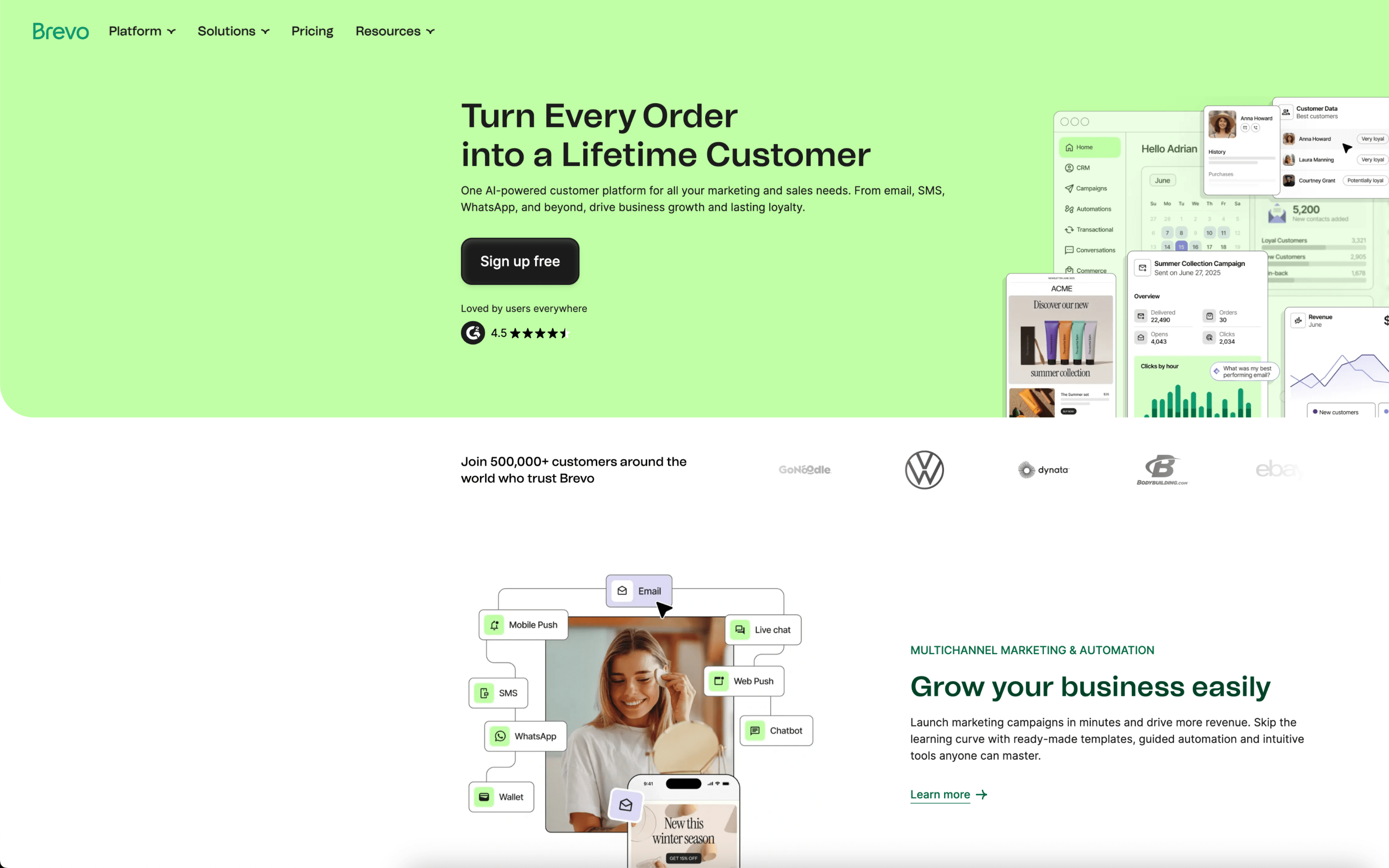
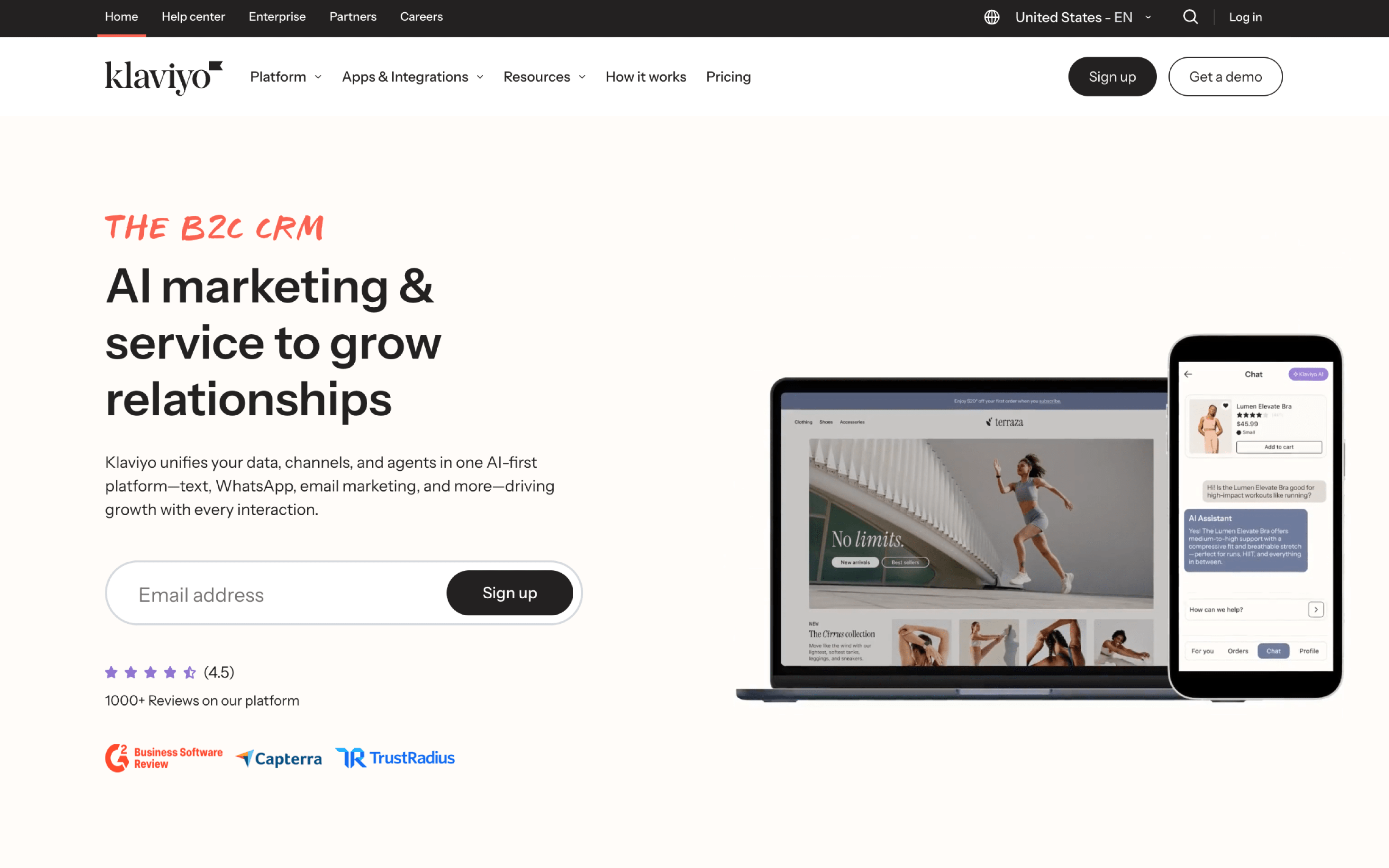
The biggest difference between Brevo and Klaviyo is what they optimize for: Brevo positions itself as an easy-to-use, all-in-one CRM suite that unifies the customer journey across channels, while Klaviyo positions itself as a data-first B2C CRM designed to turn rich customer data into highly personalized marketing. If your priority is a broader, unified workspace for customer engagement, Brevo leans that way; if your priority is deeper data-driven targeting and lifecycle automation, Klaviyo leans that way.

That split exists because Brevo evolved from email marketing into a broader CRM suite (formerly Sendinblue), emphasizing a single platform view of the customer journey, while Klaviyo started in 2012 as a customer database built to solve the “customer data problem” and then expanded into marketing automation, analytics, and service around its built-in data platform. In practice, Brevo’s product bets favor breadth and accessibility, whereas Klaviyo’s bets favor depth in customer data unification and activation.

For buyers, this difference shapes how much of your growth motion can run on unified customer profiles versus how much your team relies on an all-in-one suite to keep work consolidated. Expect the rest of this comparison to dig into how each approach affects automation sophistication, segmentation depth, omnichannel coordination, and the day-to-day operating overhead required to keep data, campaigns, and customer touchpoints aligned.

Quick Comparison

At a Glance

Category Brevo Klaviyo
Best for Businesses of all sizes B2C ecommerce brands
Core strength CRM suite, messaging channels Customer data platform
Automation depth Automation templates, basic segmentation Flow library, predictive segmentation
Pricing model Usage based email sends Active profile based pricing
Learning curve Drag and drop editor No code flow builder

Vendor Snapshot

Company Snapshot

Background data gathered from our market research (founding year, HQ, team size, specialties, etc.).

13+ years operating Team 501-1000
Founded
2012
HQ
Paris, Île-de-France, France
Team
501-1000
Industry
Customer Relationship Management (CRM)

Brevo (formerly Sendinblue) is a customer relationship management (CRM) suite designed to help businesses manage the customer journey in one platform and grow long-term customer relationships.

Specialties

Business Phone Solutions Chat Deliverability Digital Marketing Email Marketing Landing Pages Marketing Automation Meetings
K
13+ years operating Team 1001-5000
Founded
2012
HQ
Boston, Massachusetts, USA
Team
1001-5000
Industry
B2C CRM

Klaviyo is a B2C CRM powered by a built-in data platform and AI, combining marketing automation, analytics, and customer service into one unified solution to help businesses understand customers and grow.

Why These Platforms Feel So Different

Brevo began in Paris in 2012 as Sendinblue, focused on making email and SMS sending accessible from one system. Klaviyo also started in 2012 in Boston, but it began as a customer database to make brand data usable. One started from message delivery needs, while the other started from the data unification problem.

Because Brevo grew from an email-centric foundation, it prioritizes sending capacity and channel breadth inside a single suite. This leads to tradeoffs in how deeply any single domain can be modeled. A concrete sign of this origin is how Brevo’s identity is still tied to deliverability and messaging channels in its positioning.

Because Klaviyo was built to fix fragmented customer data, it prioritizes a unified customer profile and long-term event history. This creates tradeoffs in scope, since the platform’s center of gravity stays anchored in capturing and organizing interactions. You can see that philosophy in Klaviyo’s framing of “lifetime retention” of data and profiles that collect clicks, purchases, and interactions.

Those starting assumptions explain why the two products feel different once you get past surface-level similarities. The next sections show how these early priorities translate into practical differences during setup and day-to-day operation.

Key Takeaways

Key Differences

Brevo and Klaviyo differ across core areas like target market, pricing basis, data depth, automation approach, integrations, and CRM scope.

Market focus

Ecommerce-first vs general-purpose

Brevo supports broad marketing and CRM use cases, while Klaviyo is primarily built for ecommerce and B2C lifecycle marketing.

Pricing model

Email volume vs profile-based pricing

Brevo pricing is largely driven by email sending volume, while Klaviyo pricing scales mainly with active profiles in your database.

Data & segmentation

Standard segmentation vs predictive depth

Brevo emphasizes practical list and behavior segmentation, while Klaviyo emphasizes unified profiles with more advanced, predictive segmentation.

Automation model

Template-led vs data-triggered flows

Brevo leans on ready-made automation templates, while Klaviyo emphasizes deeply conditional flows triggered by real-time commerce and event data.

Integrations

Broad connectors vs ecommerce ecosystem

Brevo offers a wide set of integrations across tools, while Klaviyo focuses on deeper ecommerce, ads, and storefront data integrations.

CRM scope

Built-in sales CRM vs marketing CRM

Brevo includes sales CRM capabilities alongside messaging, while Klaviyo positions CRM around marketing, service, and analytics for B2C brands.

Feature Comparison

Feature-by-feature comparison

Comparison of core messaging channels, automation, data, and commerce-oriented capabilities.

Email marketing

Email creation, sending, and campaign management tools.

Brevo

Email marketing with drag-and-drop editor, templates, and personalization.

Klaviyo

Email marketing for campaigns and automated messaging.

SMS marketing

SMS campaigns, consent, and automation capabilities.

Brevo

SMS marketing included alongside email in the platform.

Klaviyo

SMS and MMS marketing with segmentation and automation.

WhatsApp messaging

WhatsApp marketing and automated messaging support.

Brevo

WhatsApp campaigns supported within the suite.

Klaviyo

Native WhatsApp marketing and two-way messaging on platform.

Mobile and web push

Push notification sending and automation support.

Brevo

Mobile and web push available on higher-tier plans.

Klaviyo

Mobile push supported as an omnichannel marketing channel.

Marketing automation

Triggered flows and lifecycle automation tools.

Brevo

Marketing automation with prebuilt ecommerce automations and workflows.

Klaviyo

Flows for omnichannel automation across email, SMS, push, and more.

Segmentation

Audience building using behavioral and profile data.

Brevo

Advanced segmentation available for targeting campaigns.

Klaviyo

Advanced segmentation with flexible conditions and real-time updates.

Customer profiles and CDP

Unified customer data and profile management.

Brevo

Unified customer view across store, web, and campaign data.

Klaviyo

Built-in CDP with unified customer profiles and real-time data.

Landing pages and popups

On-site capture and conversion page tools.

Brevo

Landing pages and popups supported for lead capture.

Klaviyo

Web form builder for targeted pop-up, fly-out, and embedded forms.

Transactional email

Operational emails via API or SMTP delivery.

Brevo

Transactional email supported for sending operational messages.

Klaviyo

Transactional emails supported alongside promotional and automated emails.

Product reviews

Collecting and using customer product reviews.

Brevo

Klaviyo

Reviews product available to request and collect customer feedback.

Feature Analysis

Feature Explanation: How These Capabilities Differ in Practice

The matrix shows what each tool includes. This section explains how those capabilities typically work when you’re building, sending, and measuring campaigns day to day.

#1 Automation & Flows

Brevo provides automation features, including contact scoring, and supports advanced data modeling via custom objects.

Klaviyo centers automation around multi-channel flows that can orchestrate email, SMS, WhatsApp, and mobile push from one place.

#2 Customer Segmentation

Brevo supports segmentation and also includes contact scoring, which can be used to prioritize and target contacts.

Klaviyo segments can be built from any data source connected to its built-in data platform and update in real time.

#3 Multichannel Messaging

Brevo supports SMS and also offers Mobile & Web Push as channels, alongside email.

Klaviyo runs email, SMS, WhatsApp, and mobile push in the same automation and reporting layer, using one shared customer profile.

#4 Data Model & Customer Profiles

Brevo supports custom objects, letting you extend records beyond basic contact fields for more structured data.

Klaviyo’s data platform unifies events and attributes into real-time customer profiles used directly for targeting and triggers.

#5 Ecommerce Integrations

Brevo supports ecommerce-oriented capabilities, including advanced ecommerce features, and connects with a broad set of integrations.

Klaviyo emphasizes pre-built ecommerce integrations and uses those connections to activate third-party events inside flows and segments.

#6 Analytics & Attribution

Brevo includes reporting features; users commonly evaluate performance through standard campaign and automation reporting.

Klaviyo positions reporting around cross-channel measurement, including multi-touch attribution that connects interactions to purchases.

Pricing

Pricing & Plans

Compare tiers, caps, and upgrade paths at a glance.

Brevo

Tiered Volume pricing

Brevo publishes tiered monthly pricing by contact volume with email send allowances per tier.

Klaviyo

Tiered Free tier Volume pricing

Klaviyo prices primarily by active profile (contact) volume with published tiers and custom pricing at higher volumes.

Free contacts
250
1,000 contacts

PLAN

$17

per month

What's included

  • Includes 10,000 emails
  • Tiered pricing by contacts
  • Monthly email send allowance included
  • SMS available

Limitations

  • Email sends are capped to 10,000/month at this tier; higher volume requires upgrading.

PLAN

$30

per month

What's included

  • Includes 10,000 emails
  • Tiered pricing by contacts
  • Monthly email send allowance included
  • SMS available

Limitations

  • Email sends are capped to 10,000/month at this tier; higher volume requires upgrading.
10,000 contacts

PLAN

$69

per month

What's included

  • Includes 100,000 emails
  • Tiered pricing by contacts
  • Monthly email send allowance included
  • SMS available

Limitations

  • Email sends are capped to 100,000/month at this tier; higher volume requires upgrading.

PLAN

$150

per month

What's included

  • Includes 100,000 emails
  • Tiered pricing by contacts
  • Monthly email send allowance included
  • SMS available

Limitations

  • Email sends are capped to 100,000/month at this tier; higher volume requires upgrading.
50,000 contacts

PLAN

$399

per month

What's included

  • Includes 500,000 emails
  • Tiered pricing by contacts
  • Monthly email send allowance included
  • SMS available

Limitations

  • Email sends are capped to 500,000/month at this tier; higher volume requires upgrading.

PLAN

$720

per month

What's included

  • Includes 500,000 emails
  • Tiered pricing by contacts
  • Monthly email send allowance included
  • SMS available

Limitations

  • Email sends are capped to 500,000/month at this tier; higher volume requires upgrading.
100,000 contacts

PLAN

$669

per month

What's included

  • Includes 1,000,000 emails
  • Tiered pricing by contacts
  • Monthly email send allowance included
  • SMS available

Limitations

  • Email sends are capped to 1,000,000/month at this tier; higher volume requires upgrading.

PLAN

$1,380

per month

What's included

  • Includes 1,000,000 emails
  • Tiered pricing by contacts
  • Monthly email send allowance included
  • SMS available

Limitations

  • Email sends are capped to 1,000,000/month at this tier; higher volume requires upgrading.
500,000 contacts

PLAN

$2,447

per month

What's included

  • Includes 5,000,000 emails
  • Tiered pricing by contacts
  • Monthly email send allowance included
  • SMS available

Limitations

  • High-volume operations may require additional governance (e.g., deliverability/compliance processes) beyond basic self-serve setup.

PLAN

Contact sales

What's included

  • Includes custom emails
  • Custom pricing at higher volumes
  • Email allowance is custom at this tier
  • SMS available

Limitations

  • Requires sales engagement for pricing (custom quote) at this contact volume.
1,000,000 contacts

PLAN

$45,473

per month

What's included

  • Includes 10,000,000 emails
  • Tiered pricing by contacts
  • Monthly email send allowance included
  • SMS available

Limitations

  • At very high volumes, operational requirements (e.g., deliverability review and throughput management) are common before scaling sending.

PLAN

Contact sales

What's included

  • Includes custom emails
  • Custom pricing at higher volumes
  • Email allowance is custom at this tier
  • SMS available

Limitations

  • Requires sales engagement for pricing (custom quote) at this contact volume.

Customer Voices

Reviews & Ratings

See how Brevo vs Klaviyo compare based on verified customer reviews (pros, cons, sentiment).

Brevo

4.6 / 5.0

Based on 3,339 reviews

Positive sentiment
Top Pros
  • Easy setup and intuitive interface
  • Good value, generous free plan
  • Automation and segmentation save time
  • Helpful support when issues come up
Top Cons
  • Platform can feel slow or laggy
  • Email limits can block larger sends
  • Deliverability issues and sudden account suspensions
  • Forms and WordPress plugin feel buggy

Klaviyo

4.6 / 5.0

Based on 512 reviews

Positive sentiment
Top Pros
  • Powerful segmentation for targeted campaigns
  • Flows are easy to build
  • Works especially well with Shopify
  • Strong analytics and performance tracking
Top Cons
  • Pricing gets expensive as lists grow
  • Pricing structure feels confusing
  • Editor glitches can cause lost work
  • Advanced analytics costs extra

Real-World Scenarios

How Brevo and Klaviyo differ in real marketing workflows

Feature checklists don’t show how work actually moves day to day. These scenarios highlight how each platform behaves once campaigns, data, and approvals are in motion.

#1 Ongoing campaign production

Brevo: Teams run recurring newsletters with simple handoffs, keeping cadence steady and making quick edits without disrupting the weekly send rhythm.

Klaviyo: Teams build recurring sends around deeper segmentation, spending more time on weekly refinements and testing cycles to keep messages aligned to behavior.

#2 Behavior-based customer journeys

Brevo: Teams manage ongoing journeys with lighter branching, updating steps occasionally and relying on consistent timing to keep automations running with minimal upkeep.

Klaviyo: Teams adapt journeys frequently as behavior shifts, reviewing performance weekly and making recurring adjustments to keep lifecycle paths synchronized with customer activity.

#3 Multichannel coordination across touchpoints

Brevo: Teams coordinate email with additional touchpoints in planned bursts, using straightforward workflows to keep timing aligned when launching promotions or announcements.

Klaviyo: Teams coordinate channels around ongoing behavior signals, adjusting cadence continuously so messages change as customers browse, abandon, or return across weeks.

#4 Audience updates and targeting changes

Brevo: Teams refresh audiences on a daily or weekly rhythm, making broad adjustments that support consistent sends and simpler list management workflows.

Klaviyo: Teams update targeting continuously as new events arrive, using ongoing refinements that tighten who receives what message each day.

#5 Ecommerce data handling in day-to-day operations

Brevo: Teams use purchase signals for recurring follow-ups, with occasional tuning when products change and a steady cadence for post-purchase communication.

Klaviyo: Teams operate with granular commerce behavior in ongoing workflows, revising messages weekly based on category interest, repeat patterns, and shifting customer intent.

#6 Performance visibility and reporting rhythm

Brevo: Teams check results weekly for directional visibility, making simple adjustments to timing and content while keeping recurring campaign workflows stable.

Klaviyo: Teams review performance continuously, running recurring experiments and tightening cadence based on what segments and journeys are changing week to week.

Decision Guide

Which Platform Should You Choose?

Use these cues to quickly see which platform fits how you work.

Brevo

Best for

Teams that run lean, generalist marketing operations where one or two people manage many moving parts and need a steady, repeatable cadence.

This platform is a good fit if:

  • You’re juggling multiple responsibilities, and marketing work happens in short blocks between other priorities.
  • Your team prefers a small set of repeatable programs that get reviewed and refreshed on a regular schedule.
  • Campaign planning is driven by a simple calendar (weekly/monthly), with occasional bursts when something changes in the business.
  • Workflows are often owned end-to-end by one person, from building to sending to checking results.

Klaviyo

Best for

Teams that operate in a revenue-ops rhythm where messaging is continuously tuned based on customer behavior, with frequent iteration and tight performance check-ins.

This platform is a good fit if:

  • Your team checks performance frequently (often daily) and adjusts messaging based on what customers did most recently.
  • You run multiple concurrent lifecycle programs, and ownership is split across roles (strategy, creative, analysis).
  • Campaigns are updated in response to inventory, launches, promotions, or shifts in demand rather than a fixed calendar alone.
  • Workflows depend on clean customer data definitions, and you regularly revisit audience rules as your business evolves.

Need-to-know

Frequently Asked Questions

Everything you need to know about comparing these platforms.

How much work is it to migrate lists, templates, and automations from Brevo to Klaviyo (or the other way around)?

Expect contacts and core fields to move via CSV exports/imports on both Brevo and Klaviyo, but automations, segmentation logic, and template styling typically require rebuilds rather than a one-click transfer.

To preserve reporting continuity, teams often export historical campaign metrics from Brevo or Klaviyo separately and treat post-migration results as a new baseline, since event schemas and attribution models may not match 1:1.

What happens if we switch to Brevo or Klaviyo and later need to reverse the decision—will we be stuck?

You can switch away by exporting contacts and key properties from Brevo or Klaviyo and importing them into the new system, but you should plan to recreate journeys/flows and re-implement tracking tags or SDKs.

Also account for sender/domain warm-up and reputation changes when you move sending platforms; changing from Klaviyo to Brevo (or vice versa) can require a controlled ramp to protect deliverability.

Do we actually own our data, and can we export everything we need from Brevo or Klaviyo?

Both Brevo and Klaviyo support exporting contacts and many related fields (commonly via CSV), but not every object is guaranteed to be exportable in a single, perfectly normalized dump (for example, certain aggregated analytics views or UI-only configurations).

If you need a complete archive for BI, confirm which events, message logs, and engagement metrics are accessible via export or API on Brevo and Klaviyo before you commit.

How do Brevo and Klaviyo handle GDPR/consent requirements if we operate in the EU or multiple regions?

Both Brevo and Klaviyo are commonly used in GDPR-governed environments, but compliance depends on how you collect, store, and action consent (e.g., double opt-in settings, lawful basis tracking, and suppression handling) rather than the tool alone.

If you have region-specific rules, make sure your consent fields and subscription statuses are mapped consistently during imports and that your forms/checkout consent capture is correctly connected to Brevo or Klaviyo.

We run multiple stores/brands—can we keep them separate without mixing audiences or reporting?

Multi-brand setups are possible in both Brevo and Klaviyo, but the practical approach varies: some teams use separate accounts/workspaces, while others rely on strict segmentation and dedicated sending identities.

If you need hard separation for compliance or operations, confirm how Brevo and Klaviyo isolate users, permissions, data, and sender domains across brands before consolidating into one instance.

Are there API limits or integration constraints that could break our data syncs with Brevo or Klaviyo?

Both Brevo and Klaviyo provide APIs and prebuilt integrations, but API usage is subject to rate limits and payload constraints that can affect high-frequency events, backfills, or large catalog/customer syncs.

If you rely on near-real-time triggers, confirm the integration’s sync frequency and what happens on retries/errors (queueing, deduplication, and partial failures) for your Brevo or Klaviyo setup.

What SMS rules or regional restrictions could prevent us from texting customers through Brevo or Klaviyo?

SMS sending is tightly regulated (opt-in, STOP/HELP keywords, sender IDs, quiet hours, and country-specific rules), and both Brevo and Klaviyo require compliant consent and formatting to send reliably.

Coverage and requirements differ by destination country (e.g., sender ID registration or local number rules), so validate your target regions and compliance workflow in Brevo or Klaviyo before launching SMS programs.

If deliverability drops, what controls do we have in Brevo or Klaviyo to protect sending reputation?

Deliverability protection typically involves list hygiene (suppressing hard bounces/complaints), controlled ramp-ups, and separating transactional vs marketing streams; both Brevo and Klaviyo support suppression handling and segmentation to limit risky sends.

For deeper control, confirm how each platform supports domain authentication (SPF/DKIM), dedicated sending options (where applicable), and monitoring of bounce/complaint signals within Brevo or Klaviyo.

What should we expect from support—especially during onboarding or if something breaks mid-campaign?

Support access and response speed can vary by plan and channel (ticketing, chat, onboarding services), so don’t assume 24/7 coverage unless it’s explicitly included in your Brevo or Klaviyo agreement.

For launch-critical use, confirm escalation paths, SLA expectations, and what assistance is available for deliverability incidents or integration outages in Brevo and Klaviyo.

Are there scaling limits that show up later—like performance issues with huge lists, high event volume, or frequent sends?

At scale, constraints tend to appear in event ingestion rates, sync backfills, segmentation/query performance, and governance (permissions, auditing, and workflow complexity) rather than basic send capability.

If you expect rapid growth, verify how Brevo and Klaviyo handle large imports, high-frequency behavioral events, and operational controls (naming conventions, access controls, and change management) to avoid bottlenecks.

Final Thoughts

Our Recommendation

This choice is about how your team runs messaging day to day: coordinated, multi-threaded execution versus a tighter routine with fewer moving parts.

Choose Brevo when you manage varied stakeholder inputs, shifting priorities, and multiple parallel workflows that need regular coordination. It fits teams that can absorb some operational overhead to keep cadence flexible across initiatives and channels.

Choose Klaviyo when you want a more predictable operating rhythm and a narrower set of repeatable workflows. It suits lean teams that prefer straightforward execution, clear handoffs, and minimal maintenance as volume scales.

Once you map the decision to your cadence, coordination load, and tolerance for overhead, the right platform is obvious. Pick Brevo for coordinated complexity; pick Klaviyo for streamlined, consistent execution.