All Features on Every Plan. No Lock-In.

Brevo vs Constant Contact

A side-by-side comparison for teams choosing between Brevo and Constant Contact.

Last updated: December 16, 2025

Screenshot
vs
Screenshot

Quick Overview

All-in-one customer suite vs guided email marketing

The biggest difference between Brevo and Constant Contact is platform ambition: Brevo positions itself as a broader customer relationship management (CRM) suite that unifies the customer journey in one platform, while Constant Contact emphasizes simplifying and amplifying digital marketing with an email-first approach that expands into adjacent channels. If you want one system to centralize engagement across touchpoints, Brevo leans that way; if you value a more straightforward marketing hub anchored in email, Constant Contact prioritizes that.

That tradeoff exists because their product bets started from different places and grew outward in different directions. Brevo (formerly Sendinblue, founded in 2012) frames its value around a “unified view” of the customer journey, so its messaging naturally pulls toward consolidation and cross-channel coordination inside one suite; Constant Contact traces back to a mission launched in 1995 to help small businesses compete, evolving from email marketing into a broader digital marketing solution designed to reduce complexity and keep execution approachable.

In practice, this difference changes what your stack looks like and how you operate it. With Brevo, the upside is tighter alignment between customer data and multi-channel engagement in a single environment, but that can raise expectations around process and ownership. With Constant Contact, the upside is streamlined marketing execution with email at the center, but growth may hinge on how far its marketing workspace can stretch before you need additional systems for deeper lifecycle orchestration.

Quick Comparison

At a Glance

Category Brevo Constant Contact
Best for Email, SMS, CRM users Small business email marketers
Core strength CRM suite with messaging Digital marketing tools suite
Automation depth Abandoned cart, win-back workflows Welcome, birthday, drip campaigns
Pricing model Usage-based monthly email plans Contact-tiered monthly plans
Learning curve User-friendly, some UI challenges Simple setup, interface learning

Vendor Snapshot

Company Snapshot

Background data gathered from our market research (founding year, HQ, team size, specialties, etc.).

13+ years operating Team 501-1000
Founded
2012
HQ
Paris, Île-de-France, France
Team
501-1000
Industry
CRM Suite

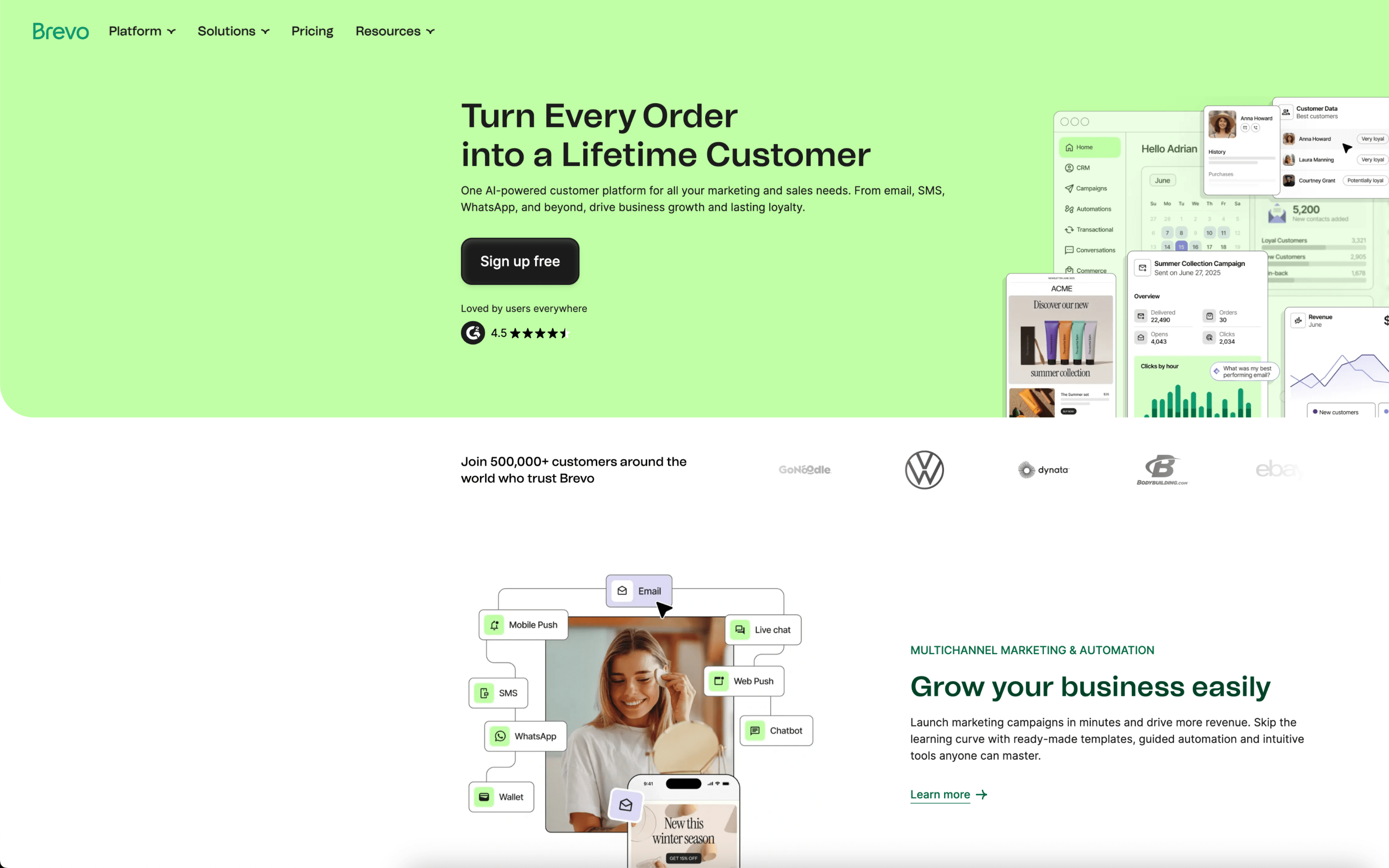
Brevo (formerly Sendinblue) is a customer relationship management (CRM) suite designed to help businesses cultivate long-term customer relationships by unifying the customer journey in an easy-to-use platform.

Specialties

Email Marketing Marketing Automation SMS Marketing Deliverability Chat Landing Pages Digital Marketing Sales CRM

Constant Contact

Visit website
C
30+ years operating Team 1001-5000
Founded
1995
HQ
Waltham, MA, USA
Team
1001-5000
Industry
Digital Marketing

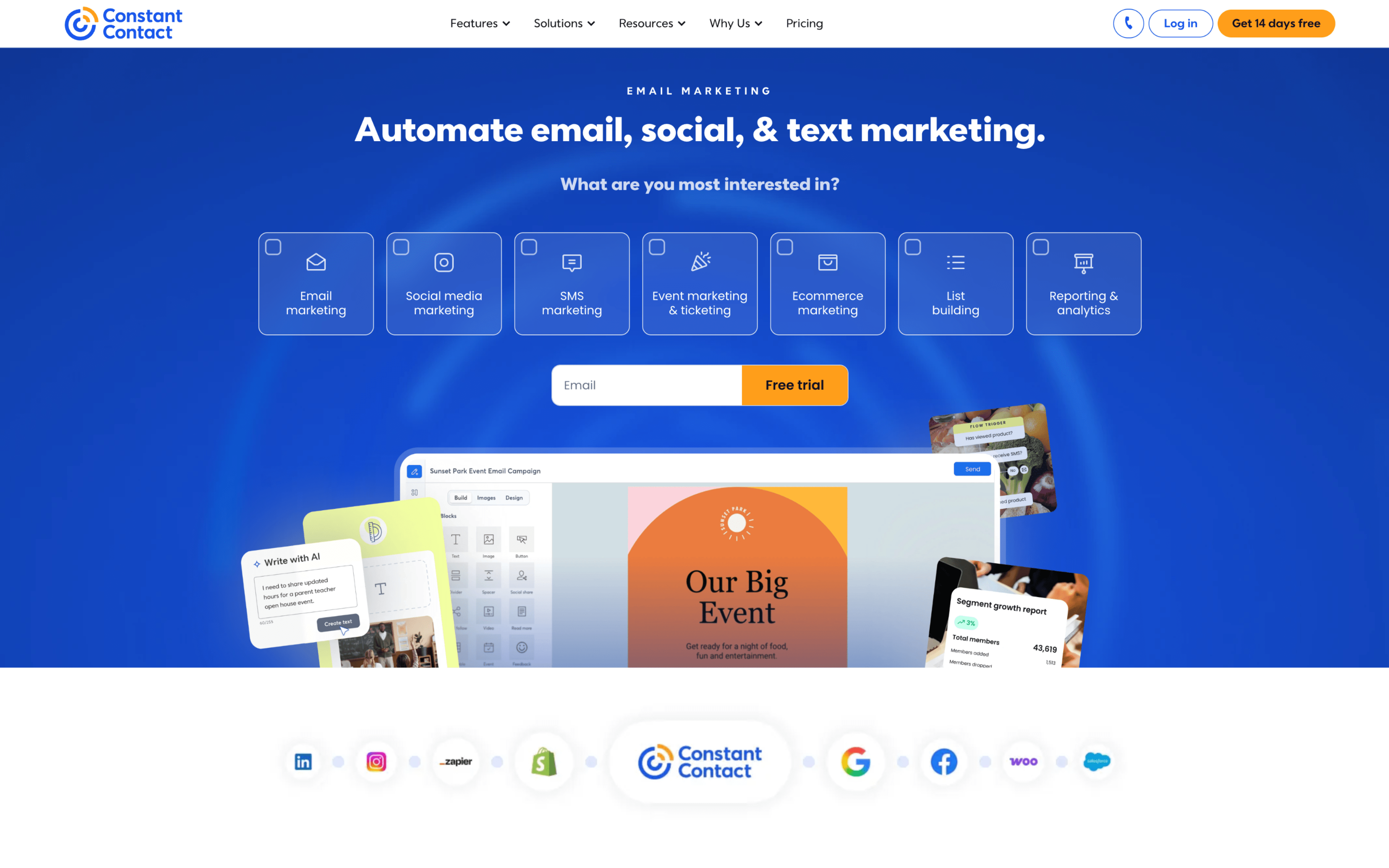
Constant Contact provides small businesses with tools to simplify and amplify digital marketing, helping drive sales, grow customer bases, and engage audiences through stronger connections and measurable results.

Specialties

Email Automation Email Marketing Social Media Marketing SMS Sales Automation CRM Marketing Analytics Fundraising

Why These Platforms Feel So Different

Brevo began in 2012 in Paris and grew out of modern web messaging needs, shaped by API-first delivery and scaling constraints. Constant Contact traces back to 1995, when the core problem was helping organizations send newsletters reliably during the early web era. Those starting points pushed Brevo toward infrastructure-minded building blocks, while Constant Contact grew around guided campaign creation.

Because Brevo was built in a later, integration-heavy environment, it prioritizes a unified system that can coordinate multiple channels from one backend. This leads to more configuration surfaces and more moving parts to manage. A concrete example is how its product lineup expands beyond email into SMS, WhatsApp, chat, and a sales CRM under one suite.

Because Constant Contact started as email marketing in 1995, it optimizes for a structured workflow that keeps sending and list upkeep consistent. This leads to a product that adds adjacent capabilities as modules, rather than reorganizing everything around a single shared data model. One visible result is the emphasis on template-led campaign building and add-on areas like events, surveys, and social posting.

These origin choices created durable defaults in how each platform is organized and extended. The next sections examine how those defaults surface as practical differences during setup, execution, and ongoing management.

Key Takeaways

Key Differences

Brevo and Constant Contact differ most in how they price, automate, expand to other channels, and fit into broader customer data workflows.

Pricing model

Usage-based vs list-based billing

Brevo pricing is primarily tied to email volume, while Constant Contact pricing mainly scales with the number of contacts.

Automation model

Richer flows vs simpler sequences

Brevo emphasizes multi-step marketing automation journeys, while Constant Contact focuses more on straightforward autoresponders and basic drip paths.

Channel mix

Broader messaging channels

Brevo centers on email plus SMS, WhatsApp, and push, while Constant Contact is more email-first with add-on SMS and social tools.

CRM & sales workflow

Built-in CRM vs email-centric lists

Brevo includes deeper CRM-style contact management, while Constant Contact is primarily built around email lists and subscriber management.

Data & personalization

Unified customer view vs campaign reporting

Brevo aims to unify store, web, and campaign data for targeting, while Constant Contact emphasizes accessible reporting on campaigns and audiences.

Scalability & admin

Advanced configuration vs ease-first setup

Brevo supports more advanced configuration for multi-channel workflows, while Constant Contact prioritizes faster setup for small-team email programs.

Feature Comparison

Feature-by-feature comparison

Comparison covers core messaging, automation, audience, and go-to-market capabilities.

Email marketing

Create, send, and manage email campaigns.

Brevo

Drag-and-drop editor with templates and AI content generator.

Constant Contact

Drag-and-drop email templates with AI writing assistance.

Marketing automation

Build automated workflows and triggered messages.

Brevo

Marketing automation with AI send-time optimization support.

Constant Contact

Automation for welcome, birthday, and drip campaigns.

SMS marketing

Send and manage text message campaigns.

Brevo

SMS marketing included for campaigns.

Constant Contact

SMS marketing included on Premium plan.

WhatsApp campaigns

Create and send WhatsApp marketing messages.

Brevo

WhatsApp campaigns available.

Constant Contact

Mobile and web push

Push notifications for web and mobile audiences.

Brevo

Mobile and web push included on higher tiers.

Constant Contact

Landing pages

Build pages to capture leads and signups.

Brevo

Landing pages included on Standard plan.

Constant Contact

Landing pages available for list growth.

Contact segmentation

Target audiences using segments and filters.

Brevo

Advanced segmentation included; supports contact scoring on higher tiers.

Constant Contact

Segmentation by behavior and engagement; custom segments on Premium.

A/B testing

Test variations to improve campaign performance.

Brevo

A/B testing included on Standard plan.

Constant Contact

Subject line A/B testing included.

Surveys and polls

Collect feedback with polls and survey tools.

Brevo

Constant Contact

Polls and surveys included.

Integrations

Connect with third-party tools and platforms.

Brevo

Integrates with tools like PayPal, WordPress, and Google Sheets.

Constant Contact

300+ integrations; connects with ecommerce, CRM, and design tools.

Feature Analysis

Feature Explanation: How These Capabilities Differ in Practice

You’ve already seen which boxes each platform checks. This section clarifies how those capabilities behave day-to-day when you actually use them.

#1 Multichannel Messaging

Brevo supports email plus channels like SMS, WhatsApp, and push, managed from the same platform.

Constant Contact focuses primarily on email marketing and social posting, rather than WhatsApp or push messaging.

#2 Automation & Flows

Brevo is built around automation use cases like abandoned cart and post-purchase, with controls like frequency caps and send-time optimization.

Constant Contact supports autoresponders and drip campaigns, while conditional automation paths are limited to higher-tier plans.

#3 Segmentation & Personalization

Brevo segments using unified store, web, and campaign data, letting you target groups like VIPs or cart abandoners.

Constant Contact supports list segmentation and personalization using contact data, with dynamic content tools on Premium.

#4 Testing & Optimization

Brevo supports A/B testing for elements like subject lines, offers, and CTAs.

Constant Contact offers campaign reporting for opens and clicks, but testing options are less central in its workflow.

#5 Reporting & Analytics

Brevo tracks performance with metrics like conversions and revenue-related reporting in real time.

Constant Contact reporting focuses on engagement metrics like open rates, click-throughs, and trends by campaign.

#6 Contact Data & Integrations

Brevo supports contact management tied to automation, and teams often use its API to move contacts into segments and lists.

Constant Contact supports importing contacts manually or via integrations, plus list segmentation and engagement tracking.

Pricing

Pricing & Plans

Compare tiers, caps, and upgrade paths at a glance.

Brevo

Tiered Volume pricing

Public, tiered monthly pricing based on contact count with defined email send allowances per tier.

Constant Contact

Tiered Volume pricing

Tiered pricing by contact count with public pricing at lower tiers and sales-contacted (custom) pricing at higher volumes.

1,000 contacts

PLAN

$17

per month

What's included

  • Includes 10,000 emails
  • Email campaigns
  • Contact management
  • Audience segmentation

Limitations

  • Email sending is capped at 10,000 emails/month at this contact level; higher volume requires an upgrade.

PLAN

$30

per month

What's included

  • Includes 10,000 emails
  • Email campaigns
  • Contact list management
  • Audience segmentation

Limitations

  • Email sending is capped at 10,000 emails/month at this contact level; higher volume requires an upgrade.
10,000 contacts

PLAN

$69

per month

What's included

  • Includes 100,000 emails
  • Email campaigns
  • Contact management
  • Audience segmentation

Limitations

  • Email sending is capped at 100,000 emails/month at this contact level; higher volume requires an upgrade.

PLAN

$120

per month

What's included

  • Includes 100,000 emails
  • Email campaigns
  • Contact list management
  • Audience segmentation

Limitations

  • Email sending is capped at 100,000 emails/month at this contact level; higher volume requires an upgrade.
50,000 contacts

PLAN

$399

per month

What's included

  • Includes 500,000 emails
  • Email campaigns
  • Contact management
  • Audience segmentation

Limitations

  • Email sending is capped at 500,000 emails/month at this contact level; higher volume requires an upgrade.

PLAN

$430

per month

What's included

  • Includes 500,000 emails
  • Email campaigns
  • Contact list management
  • Audience segmentation

Limitations

  • Email sending is capped at 500,000 emails/month at this contact level; higher volume requires an upgrade.
100,000 contacts

PLAN

$669

per month

What's included

  • Includes 1,000,000 emails
  • Email campaigns
  • Contact management
  • Audience segmentation

Limitations

  • Email sending is capped at 1,000,000 emails/month at this contact level; higher volume requires an upgrade.

PLAN

Contact sales

What's included

  • Includes custom emails
  • Email campaigns
  • Contact list management
  • Audience segmentation

Limitations

  • Pricing is not publicly listed at this scale and requires contacting sales for a custom quote/terms.
500,000 contacts

PLAN

$2,447

per month

What's included

  • Includes 5,000,000 emails
  • Email campaigns
  • Contact management
  • Audience segmentation

Limitations

  • High-volume programs may require additional operational controls (e.g., deliverability and compliance reviews) when scaling sending throughput.

PLAN

Contact sales

What's included

  • Includes custom emails
  • Email campaigns
  • Contact list management
  • Audience segmentation

Limitations

  • High-volume accounts require sales engagement and typically move to custom contracts/terms.
1,000,000 contacts

PLAN

$45,473

per month

What's included

  • Includes 10,000,000 emails
  • Email campaigns
  • Contact management
  • Audience segmentation

Limitations

  • At very high scale, account onboarding and sending throughput may be subject to additional review and operational requirements.

PLAN

Contact sales

What's included

  • Includes custom emails
  • Email campaigns
  • Contact list management
  • Audience segmentation

Limitations

  • At enterprise scale, pricing and sending allowances are custom and require sales-led contracting.

Customer Voices

Reviews & Ratings

See how Brevo vs Constant Contact compare based on verified customer reviews (pros, cons, sentiment).

Brevo

4.6 / 5.0

Based on 3,339 reviews

Positive sentiment
Top Pros
  • Easy setup and quick first campaigns
  • Great value, especially free tier
  • Strong templates and drag-and-drop editor
  • Responsive, helpful customer support
Top Cons
  • Occasional slow loading and lag
  • Email limits can feel restrictive
  • Account blocks happen without clear reasons
  • Forms and integrations feel limited or buggy

Constant Contact

4.3 / 5.0

Based on 2,889 reviews

Positive sentiment
Top Pros
  • Easy drag-and-drop campaign creation
  • Strong scheduling for planned sends
  • Helpful reporting and engagement analytics
  • Good customer support when you reach them
Top Cons
  • Editor formatting can be glitchy
  • Emails sometimes land in spam
  • Automation and customization feel limited
  • Cancellation and unsubscribe management is frustrating

Real-World Scenarios

How Brevo and Constant Contact behave in day-to-day marketing workflows

Feature tables show what’s available, but daily workflows reveal how quickly teams can execute, adjust, and stay consistent. These scenarios translate capabilities into operational reality.

#1 Campaign production cadence

Brevo: Teams build recurring campaigns and transactional touchpoints in one routine, with fewer handoffs and quicker weekly iteration when priorities change.

Constant Contact: Teams run regular newsletters and promos with a steady weekly rhythm, often repeating set steps to keep sends consistent across lists.

#2 Audience changes and targeting adjustments

Brevo: Segments update in ongoing cycles, so targeting shifts feel continuous; teams make quick adjustments before sends without restarting the workflow.

Constant Contact: Targeting changes are handled in discrete edits, so teams commonly review lists before each campaign to keep weekly sends aligned.

#3 Multichannel coordination during a promotion

Brevo: Teams coordinate email with other touchpoints in short bursts, keeping timing aligned and reducing manual reminders across ongoing promotional workflows.

Constant Contact: Teams focus execution around email-first bursts, coordinating other actions through separate routines and checklists to maintain cadence.

#4 Automation vs. manual handoffs

Brevo: Workflows run with more recurring automation, so handoffs happen less often; teams monitor exceptions and tune flows during ongoing operations.

Constant Contact: Teams rely more on scheduled sends and repeatable check-ins, with manual steps used to keep recurring communications on track.

#5 Reporting and performance visibility

Brevo: Teams check performance in ongoing cycles, making quick weekly adjustments to messages and timing based on what’s trending across recent activity.

Constant Contact: Teams review campaign results after each send, using a recurring report-check routine to decide the next week’s content and cadence.

#6 Contact lifecycle and list upkeep

Brevo: Contact updates are treated as ongoing housekeeping, with teams refining lifecycle states gradually to reduce repeated cleanup before major sends.

Constant Contact: List upkeep often happens in recurring maintenance sessions, with teams cleaning and reorganizing contacts ahead of campaign bursts.

Decision Guide

Which Platform Should You Choose?

Use these cues to quickly see which platform fits how you work.

Brevo

Best for

Teams that run always-on customer programs and iterate weekly based on behavior signals and internal feedback loops.

This platform is a good fit if:

  • You keep several initiatives running at once and make small changes continuously rather than launching in big batches.
  • Your team reviews engagement patterns regularly and updates segments or audiences as new data comes in.
  • Work is shared between marketing and sales/support, and handoffs happen throughout the day instead of at fixed milestones.
  • You maintain a backlog of experiments and treat each send as a learning cycle with rapid follow-ups.

Constant Contact

Best for

Teams that operate on a predictable outreach calendar and prefer completing one campaign at a time with clear checkpoints.

This platform is a good fit if:

  • You plan communications around events, announcements, and seasonal moments with a set schedule.
  • Your team builds a campaign, gets it approved, sends it, and then moves on to the next one in a repeatable rhythm.
  • List updates happen in batches (weekly or monthly) rather than being adjusted continuously day to day.
  • Reporting is reviewed after each campaign to confirm performance and document results before the next send.

Need-to-know

Frequently Asked Questions

Everything you need to know about comparing these platforms.

How much work is it to migrate my lists, templates, and automations from Constant Contact to Brevo (or the other way around)?

Plan on exporting contacts from Constant Contact and importing them into Brevo (or vice versa), then recreating forms, automations, and templates because platform-specific builders and automation logic don’t transfer 1:1.

You’ll also want to bring over suppression/unsubscribe lists and re-verify key sending domains before launching, since historical engagement signals and some tracking settings won’t carry across automatically between Brevo and Constant Contact.

What happens if I switch and then regret it—can I reverse the decision without losing everything?

You can switch away from Brevo or Constant Contact by exporting contacts and key assets you can download, but you should expect to rebuild automations and some templates in the new system rather than “rolling back” a full account state.

To reduce risk, keep a dated export of contacts (including unsubscribes) and an archive of templates before you cut over, because neither Brevo nor Constant Contact restores another platform’s configuration automatically.

Do I actually own my data, and can I export everything I’ll need if I leave later?

With both Brevo and Constant Contact, you can export contact lists and reporting data to common formats, but not every internal artifact (like automation history or some event-level logs) is always available as a complete export.

If data portability is critical, confirm you can export custom fields, tags/segments, and suppression lists in the structure you need before committing to Brevo or Constant Contact.

If I’m subject to GDPR or regional consent rules, what should I verify before using Brevo or Constant Contact?

Both Brevo and Constant Contact support consent-based marketing workflows, but you’re still responsible for configuring signup language, consent capture, and proof of consent based on your jurisdiction.

Before sending, verify how each platform stores consent fields, how unsubscribes are enforced, and what tools are available for data subject requests (export/delete) in Brevo and in Constant Contact.

I run multiple stores/brands—can I manage them under one account without mixing audiences or branding?

Multi-brand setups are possible in both Brevo and Constant Contact, but the practical approach often involves separate lists/audiences, separate sending identities, and careful permissioning to prevent cross-brand sends.

Confirm how each platform handles segmentation boundaries and user access controls so contacts from Brand A aren’t accidentally emailed by Brand B in Brevo or Constant Contact.

Will API limits or integration constraints block me if I rely on custom integrations or heavy automation?

Brevo and Constant Contact both offer APIs and prebuilt integrations, but constraints can show up as rate limits, per-endpoint restrictions, or missing coverage for specific objects (for example, certain campaign assets or reporting granularity).

If your workflow depends on near-real-time syncing, test the exact endpoints you need and confirm expected throughput and pagination behavior in Brevo versus Constant Contact before you commit.

Can I send SMS everywhere my customers live, and what regional rules could stop my campaigns?

SMS availability and requirements vary by country and carrier, so you need to confirm that Brevo or Constant Contact supports the regions you target and the sender setup required (such as dedicated numbers or brand registration where applicable).

Even when SMS is available, opt-in, quiet hours, and prohibited content rules are enforced at the carrier/regional level, so campaigns may be blocked or filtered regardless of what you configure inside Brevo or Constant Contact.

What safeguards exist if my deliverability drops or my account gets flagged for suspicious sending?

Both Brevo and Constant Contact typically enforce compliance and deliverability protections like list-quality expectations, bounce/spam monitoring, and sending reviews or restrictions when abnormal patterns appear.

If you anticipate spikes (seasonal sends, large imports), warm up sending gradually and maintain clean opt-in records, because sudden volume changes or poor list hygiene can trigger throttling or temporary limits in Brevo or Constant Contact.

What level of support should I realistically expect when something breaks right before a campaign?

Support access and response times can vary by plan and channel (email/chat/phone), and the fastest path is often through the platform’s official support portal with account details and error screenshots.

Before relying on either Brevo or Constant Contact for time-sensitive sends, confirm your included support channels, hours, and escalation options so you know what help is available during your peak campaign windows.

What are the scaling limits I might hit as my list and send volume grow?

Scaling constraints often show up as sending caps, throttling, automation throughput, or compliance reviews when volume jumps—these can affect how quickly large campaigns are delivered in Brevo or Constant Contact.

If you expect rapid growth or frequent high-volume blasts, validate the platform’s sending policies, any required verification steps, and how quickly limits can be adjusted so you don’t hit an operational ceiling mid-campaign.

Final Thoughts

Our Recommendation

This choice is about how your team runs communication day to day: a coordinated, multi-track operating rhythm versus a steady, repeatable routine.

Choose Brevo when your work runs in parallel across audiences, timing, and handoffs, and you can manage tighter coordination. It fits teams that iterate frequently and accept some operational overhead to keep moving parts aligned.

Choose Constant Contact when you need a straightforward workflow with consistent execution and minimal internal coordination. It suits smaller teams that prioritize predictability, limited maintenance, and getting campaigns out on a regular cadence.

Once you map the decision to your cadence and coordination tolerance, the right platform becomes obvious. Pick Brevo for complex operational rhythms, and pick Constant Contact for simple, repeatable execution.