All Features on Every Plan. No Lock-In.

Aweber vs Constant Contact

A side-by-side comparison for teams choosing between Aweber and Constant Contact.

Last updated: December 16, 2025

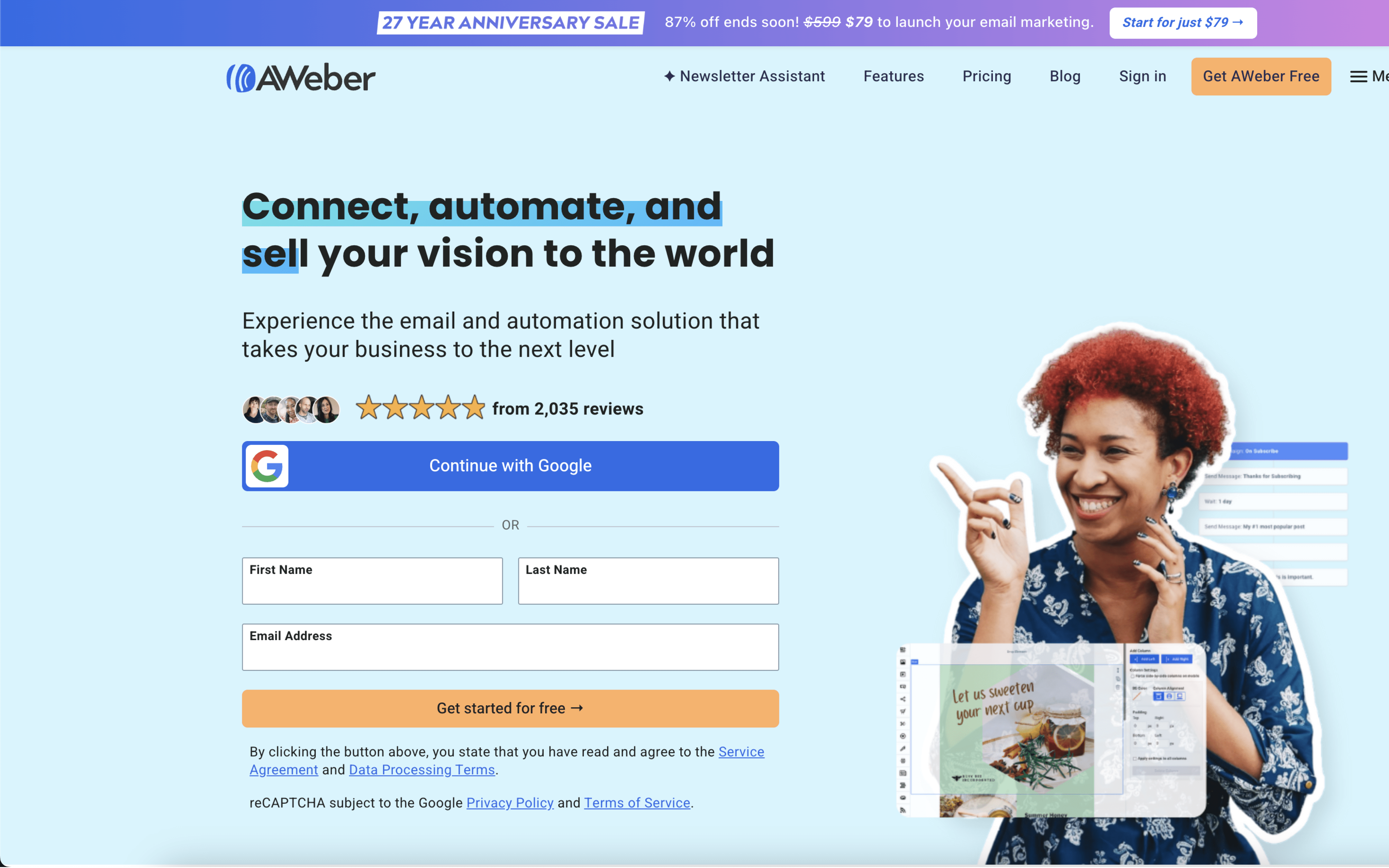
Screenshot
vs
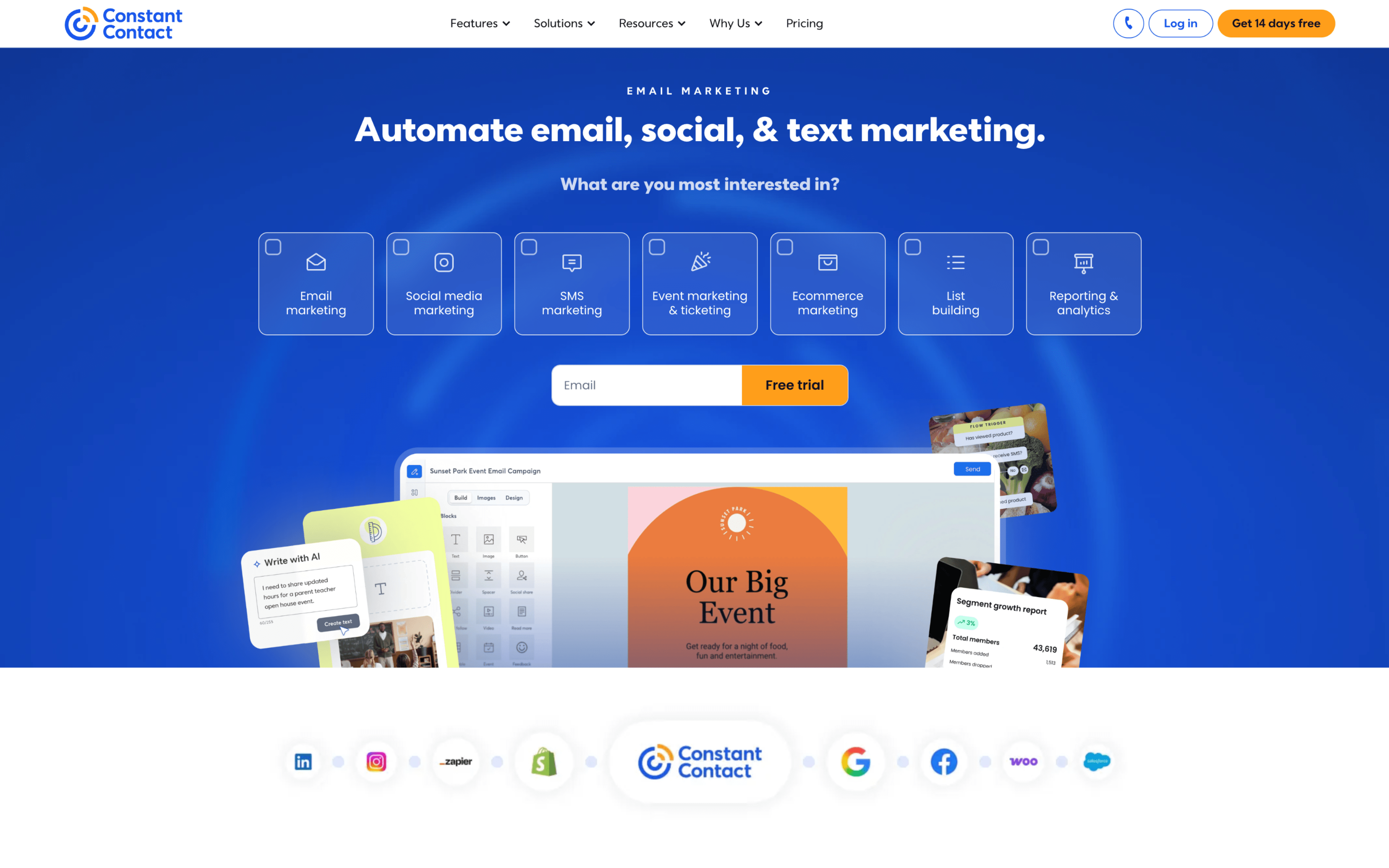
Screenshot

Quick Overview

Email-first simplicity vs broader marketing hub

The biggest difference between AWeber and Constant Contact is scope: AWeber stays tightly centered on making email marketing and follow-up automation feel straightforward, while Constant Contact frames email as one part of a broader digital marketing platform that also spans channels like social and text. If your priority is a focused email workflow with fewer moving parts, AWeber aligns with that; if you need email to sit inside a more all-in-one marketing workspace, Constant Contact is oriented that way.

That tradeoff exists because AWeber’s positioning is rooted in removing complexity from email marketing and doing the core loop—building campaigns, organizing contacts, and automating follow-ups—without heavy setup, reflecting its long history as an email-first provider (founded in 1998). In contrast, Constant Contact’s messaging emphasizes simplifying and amplifying small-business digital marketing across multiple tactics from one platform, which naturally pushes the product toward a wider surface area and more interconnected marketing data and workflows than email alone.

For buyers, this difference affects how your marketing stack evolves: whether you standardize on a dedicated email engine and keep other channels elsewhere, or centralize more of your outreach in one system. It also changes what you’ll optimize day-to-day—automation depth vs. breadth, cross-channel coordination, and the operational overhead of managing multiple tools versus one platform. The rest of the page breaks down these implications across workflow fit, segmentation expectations, and how “all-in-one” influences execution.

Quick Comparison

At a Glance

Category Aweber Constant Contact
Best for Small businesses, email marketers Small businesses, nonprofits
Core strength List management, follow-up emails Digital marketing tools suite
Automation depth Behavior triggers, split paths Welcome emails, drip campaigns
Pricing model Subscriber-based pricing tiers Contact-based pricing tiers
Learning curve Beginner-friendly, occasional friction Simple setup, easy templates

Vendor Snapshot

Company Snapshot

Background data gathered from our market research (founding year, HQ, team size, specialties, etc.).

27+ years operating Team 51-200
Founded
1998
HQ
Doylestown, PA, USA
Team
51-200
Industry
Email Marketing Software

AWeber provides powerfully simple email marketing solutions for entrepreneurs and small businesses, with features designed to reduce the complexity of email marketing. The company offers 24/7 customer support and has been remote-first since 2020.

Specialties

Automated Email Follow-Up Email Marketing Email Marketing Software Email Newsletters Marketing Automation

Constant Contact

Visit website
C
30+ years operating Team 1001-5000
Founded
1995
HQ
Waltham, MA, USA
Team
1001-5000
Industry
Digital Marketing

Constant Contact delivers tools that help small businesses simplify and amplify digital marketing, supporting efforts like driving sales, growing customer bases, and engaging audiences. It evolved from email marketing into a broader digital marketing solution for small businesses.

Specialties

Analytics Contact Management Coupons CRM Customer Engagement E-commerce Marketing Email Automation Email Design

Why These Platforms Feel So Different

AWeber and Constant Contact started in different eras and with different constraints. AWeber, founded in 1998, grew out of early online publishing needs around automated email follow-up. Constant Contact, founded in 1995, began with a mission to help smaller firms compete using email marketing.

Because AWeber was built around automated follow-up, it prioritizes repeatable sequence logic and list-level execution. This leads to a product shape that stays close to core email workflows, rather than sprawling into many adjacent modules. One visible result is its long-standing emphasis on “automated email follow-up” as a defining capability.

Because Constant Contact started with a broader “level the playing field” mission, it prioritizes packaging many related marketing tasks into one connected suite. This creates tradeoffs in depth per module, since expansion requires consistent conventions across tools. One concrete example is how its scope has grown from email into areas like events, surveys, and social, as described in its company story.

Those origin choices still influence what each platform optimizes for today. The next sections reflect how early priorities show up as practical differences and constraints.

Key Takeaways

Key Differences

AWeber and Constant Contact differ across several core dimensions that shape setup, automation, and how teams run campaigns day to day.

Market focus

Creator-first vs SMB generalist

AWeber leans toward creators and simple email marketing, while Constant Contact targets broader small-business marketing needs.

Pricing structure

Subscriber-based vs tiered access

AWeber pricing scales mainly with subscribers and keeps core access consistent, while Constant Contact gates capabilities by plan tier.

Automation model

Basic workflows vs guided automations

AWeber supports straightforward behavioral email automations, while Constant Contact emphasizes simpler, guided automation for common campaigns.

Channel breadth

Email-centric vs multi-channel tools

AWeber stays focused on email and list growth, while Constant Contact includes broader tools like social and event marketing.

Integrations

App marketplace vs all-in-one suite

AWeber relies heavily on integrations to extend capabilities, while Constant Contact offers more built-in functionality before adding apps.

Reporting depth

Email metrics vs campaign dashboards

AWeber reporting centers on email performance and list activity, while Constant Contact provides broader campaign-level reporting across channels.

Feature Comparison

Feature-by-feature comparison

Compares core email, automation, list growth, multichannel, integrations, and reporting capabilities.

Email campaign builder

Design and send marketing emails from templates or editor.

Aweber

Email campaign management with drag-and-drop tools and reliable tracking.

Constant Contact

Drag-and-drop email editor with AI writing assistance.

Marketing automation

Automated sequences triggered by subscriber events or actions.

Aweber

Behavioral triggers, split paths, and workflow versioning.

Constant Contact

Automation for welcome, birthday, and drip campaigns.

Segmentation

Create targeted audiences using contact attributes and engagement.

Aweber

Segment contacts by behavior and source for targeted campaigns.

Constant Contact

Segment contacts by behavior, engagement, and more.

Landing pages

Build standalone pages for lead capture and conversion.

Aweber

Drag-and-drop landing page builder with templates and performance tracking.

Constant Contact

Landing pages for list growth and marketing campaigns.

Sign-up forms

Capture subscribers via embedded or hosted opt-in forms.

Aweber

Built-in sign up form builder.

Constant Contact

Web forms and QR codes for subscriber collection.

SMS marketing

Send text messages for campaigns and engagement.

Aweber

Constant Contact

SMS included with Premium plan allowances.

Web push notifications

Browser push messages for subscribers and site visitors.

Aweber

Web push notifications available.

Constant Contact

Social media marketing

Publish and schedule posts with performance tracking.

Aweber

Constant Contact

Post and schedule to Facebook, Instagram, and LinkedIn.

Integrations

Connect with third-party apps to sync data and workflows.

Aweber

Integrations with website builders, ecommerce platforms, and scheduling tools.

Constant Contact

Integrates with hundreds of apps including CRM and ecommerce.

Reporting and analytics

Track engagement metrics and campaign performance over time.

Aweber

Advanced reporting and analytics available.

Constant Contact

Analytics for opens, clicks, and engagement trends.

Feature Analysis

Feature Explanation: How These Capabilities Differ in Practice

The matrix shows which boxes each platform checks. This section clarifies how the most important capabilities behave when you actually build and run campaigns.

#1 Automation & Flows

AWeber supports automation with behavioral triggers, split paths, and workflow versioning for iterating on sequences.

Constant Contact details on triggers, branching, or versioning were not found, so day-to-day flow behavior is unclear.

#2 Landing Pages & Lead Capture

AWeber includes a drag-and-drop landing page builder with templates, and it tracks landing page performance inside the platform.

Constant Contact implementation details for landing pages and performance tracking were not found, so setup and reporting behavior is unclear.

#3 Integrations & Data Sync

AWeber supports a mix of native and third-party integrations across ecommerce, websites, scheduling, and lead sources to sync contacts and trigger campaigns.

Constant Contact integration and syncing specifics were not found, so connected-app behavior is unclear.

#4 Facebook Lead Ads Capture

AWeber offers a direct Facebook Lead Ads integration to sync new leads into lists in real time for follow-up.

Constant Contact support for Facebook Lead Ads syncing was not found, so lead capture behavior is unclear.

#5 Contact Organization & List Management

AWeber organizes subscribers with lists, tags, and custom fields, and it supports pulling segments from behavioral and source data.

Constant Contact details on using tags vs lists, and how segments are built from behavior, were not found.

Pricing

Pricing & Plans

Compare tiers, caps, and upgrade paths at a glance.

Aweber

Tiered Volume pricing

Public monthly pricing scales by contact tier up to 100,000 contacts, with custom pricing at higher volumes.

Constant Contact

Tiered Volume pricing

Public monthly pricing scales by contact tier through 50,000 contacts, with custom pricing at higher volumes.

1,000 contacts

PLAN

$25

per month

What's included

  • Includes 10,000 emails
  • Email marketing priced by subscriber count (not seats)
  • Automation workflows (per product documentation)
  • Landing pages and signup forms (per product documentation)

Limitations

  • Monthly email sends are capped at 10,000 for this tier.

PLAN

$30

per month

What's included

  • Includes 10,000 emails
  • Email marketing priced by contact tier
  • SMS channel available (per pricing data)
  • List management and campaign sending (general platform capability)

Limitations

  • Monthly email sends are capped at 10,000 for this tier.
10,000 contacts

PLAN

$100

per month

What's included

  • Includes 100,000 emails
  • Email marketing priced by subscriber count (not seats)
  • Automation workflows (per product documentation)
  • List/segment management (per product documentation)

Limitations

  • Monthly email sends are capped at 100,000 for this tier.

PLAN

$120

per month

What's included

  • Includes 100,000 emails
  • Email marketing priced by contact tier
  • SMS channel available (per pricing data)
  • Reporting/analytics (general platform capability)

Limitations

  • Monthly email sends are capped at 100,000 for this tier.
50,000 contacts

PLAN

$375

per month

What's included

  • Includes 500,000 emails
  • Email marketing priced by subscriber count (not seats)
  • Automation workflows (per product documentation)
  • Reporting/analytics (per product documentation)

Limitations

  • Monthly email sends are capped at 500,000 for this tier.

PLAN

$430

per month

What's included

  • Includes 500,000 emails
  • Email marketing priced by contact tier
  • SMS channel available (per pricing data)
  • Segmentation/list tools (general platform capability)

Limitations

  • Monthly email sends are capped at 500,000 for this tier.
100,000 contacts

PLAN

$600

per month

What's included

  • Includes 1,000,000 emails
  • Email marketing priced by subscriber count (not seats)
  • Automation workflows (per product documentation)
  • Landing pages and signup forms (per product documentation)

Limitations

  • Monthly email sends are capped at 1,000,000 for this tier.

PLAN

Contact sales

What's included

  • Includes custom emails
  • Custom pricing for higher-volume lists
  • SMS channel available (per pricing data)
  • Account-specific send volume configuration

Limitations

  • Requires contacting sales for pricing and plan terms at this volume.
500,000 contacts

PLAN

Contact sales

What's included

  • Includes custom emails
  • Custom pricing for higher-volume lists
  • Account-specific send volume configuration
  • Automation and list management (per product documentation)

Limitations

  • Requires contacting sales for pricing and plan terms at this volume.

PLAN

Contact sales

What's included

  • Includes custom emails
  • Custom pricing for higher-volume lists
  • SMS channel available (per pricing data)
  • Account-specific contract and provisioning

Limitations

  • Requires contacting sales for pricing and plan terms at this volume.
1,000,000 contacts

PLAN

Contact sales

What's included

  • Includes custom emails
  • Custom pricing for highest-volume lists
  • Account-specific send volume configuration
  • Automation and reporting (per product documentation)

Limitations

  • Requires contacting sales for pricing and plan terms at this volume.

PLAN

Contact sales

What's included

  • Includes custom emails
  • Custom pricing for highest-volume lists
  • SMS channel available (per pricing data)
  • Account-specific contract and provisioning

Limitations

  • Requires contacting sales for pricing and plan terms at this volume.

Customer Voices

Reviews & Ratings

See how Aweber vs Constant Contact compare based on verified customer reviews (pros, cons, sentiment).

Aweber

4.4 / 5.0

Based on 320 reviews

Positive sentiment
Top Pros
  • Customer support is fast and helpful
  • Easy to get started for beginners
  • Simple dashboard for lists and sends
  • Reliable for basic email marketing needs
Top Cons
  • Interface feels outdated in places
  • Automation lacks branching and advanced logic
  • Price increases can be sudden
  • Template customization and editor feel clunky

Constant Contact

4.3 / 5.0

Based on 2,889 reviews

Positive sentiment
Top Pros
  • Drag-and-drop emails are quick to build
  • Scheduling campaigns is easy and convenient
  • Reporting and analytics are detailed
  • Contact syncing and list tools save time
Top Cons
  • Formatting tools can be glitchy
  • Emails sometimes land in spam
  • Account cancellation and unsubscribes feel painful
  • Pricing feels high for advanced needs

Real-World Scenarios

How the differences show up in real workflows

Features matter most when they change day-to-day workflows, handoffs, and how quickly teams can adjust. These scenarios show how each platform behaves once campaigns become recurring.

#1 Recurring newsletter production

Aweber: Teams run weekly sends with repeatable steps, reusing prior layouts and making quick adjustments without slowing approvals or handoffs.

Constant Contact: Teams coordinate weekly sends with more review checkpoints, leaning on templated routines to keep cadence steady across multiple contributors.

#2 Automated follow-ups after sign-up

Aweber: Teams manage ongoing welcome follow-ups with recurring tweaks as audience responses shift, keeping day-to-day upkeep lightweight for one person.

Constant Contact: Teams manage welcome follow-ups with periodic check-ins, adjusting messaging in bursts when lists grow or new offers rotate in.

#3 List growth and audience organization

Aweber: Teams update audiences continuously as new sign-ups arrive, keeping targeting organized through regular cleanup to reduce weekly send friction.

Constant Contact: Teams manage audiences through scheduled list maintenance, often batching updates weekly so segmentation changes align with campaign planning cycles.

#4 Event and promotion push cycles

Aweber: Teams coordinate short promotional bursts with quick edits between sends, reacting daily to performance and keeping the workflow compact.

Constant Contact: Teams coordinate promotional bursts with clearer internal checkpoints, pacing adjustments every few days to keep messaging consistent across the sequence.

#5 Reporting and performance visibility

Aweber: Teams check results routinely after each send, making small ongoing adjustments to timing and messaging without needing a separate reporting workflow.

Constant Contact: Teams review results in weekly rhythms, sharing visibility across stakeholders so follow-up actions and next sends stay aligned.

#6 Collaboration and handoffs

Aweber: Teams operate smoothly when one owner runs ongoing sends, with occasional handoffs that don’t disrupt the recurring schedule.

Constant Contact: Teams operate with more shared ownership, supporting recurring handoffs between roles so campaigns continue even when responsibilities rotate.

Decision Guide

Which Platform Should You Choose?

Use these cues to quickly see which platform fits how you work.

Aweber

Best for

Small teams or solo operators who rely on repeatable, set-and-run outreach rhythms and prefer keeping day-to-day execution lightweight.

This platform is a good fit if:

  • You publish on a steady cadence and mainly rotate between a few recurring messages rather than reinventing every send.
  • One person typically owns setup end-to-end, with occasional help from support when you hit a process snag.
  • Your list organization is handled through simple routines you repeat each week (imports, cleanups, quick segment updates).
  • You measure results in quick check-ins and make small adjustments between sends instead of running heavy analysis cycles.

Constant Contact

Best for

Organizations running calendar-driven communications where multiple stakeholders coordinate, schedule ahead, and maintain regular updates to defined groups.

This platform is a good fit if:

  • Your outreach is planned around a calendar (monthly updates, seasonal pushes, event cycles) and you queue work in advance.
  • Different people contribute to the process (drafting, approvals, sending), so handoffs and consistency matter day to day.
  • You regularly communicate with established groups like members, donors, customers, or local audiences with clear opt-in expectations.
  • Your team reviews performance after each cycle and uses those check-ins to inform the next scheduled round of communication.

Need-to-know

Frequently Asked Questions

Everything you need to know about comparing these platforms.

If I migrate, how much work is it to move my list, tags, and automations without breaking everything?

Moving contacts is typically a CSV import in both Aweber and Constant Contact, but items like tags/custom fields and engagement history often need cleanup and mapping during import.

Automations and templates generally aren’t transferred 1:1 between platforms, so expect to rebuild workflows and re-create sign-up forms and integrations after the data import.

What happens if I switch to Aweber or Constant Contact and then decide to switch back later?

You can switch away from either Aweber or Constant Contact by exporting your contacts and key fields, then importing into the next tool, but you won’t carry over automation logic or deliverability reputation automatically.

If you return later, you’ll typically be treated like a new sending environment again, which can mean re-verifying sending domains and re-warming volumes depending on what you send and how long you were away.

Do I actually own my subscriber data, and can I export everything I need at any time?

In both Aweber and Constant Contact, you can export contact lists and common fields (e.g., email, name, tags/segments where supported) for use elsewhere.

However, full historical engagement data (like complete event logs over time) and automation state may not export in a way that recreates the same behavior in another platform, so plan to retain backups of key segments and suppression lists.

We have GDPR requirements—can these tools handle consent, unsubscribes, and regional privacy rules correctly?

Aweber and Constant Contact both provide standard mechanisms for unsubscribe handling and list management, which are core requirements for GDPR-aligned email practices.

For consent, you’ll still need to configure your forms, disclosures, and record-keeping to match your specific legal basis (e.g., explicit opt-in) and ensure you can produce evidence of consent if requested.

Can I manage multiple stores or brands without mixing audiences or sending from the wrong identity?

Both Aweber and Constant Contact can support separating audiences through lists, tags, and segmentation, but you should expect to design a clear naming and permission structure to prevent cross-sends.

If you need strict separation (different brands, domains, teams, or compliance boundaries), confirm whether you’ll use separate accounts versus in-account segmentation, since that impacts reporting separation and administrative access.

Are there API limits or integration constraints that could block us once we connect our CRM, site, or custom app?

Aweber and Constant Contact offer APIs and prebuilt integrations, but API usage is typically subject to authentication requirements, endpoint availability, and rate limiting that can affect high-volume syncs.

If your workflow depends on near-real-time updates (e.g., frequent tag changes or event pushes), validate the integration’s sync frequency and confirm what objects can be created/updated via API before committing.

If we add SMS later, what regional rules or carrier restrictions might stop messages from going out?

SMS programs are constrained by country-specific rules (opt-in language, sender IDs, quiet hours, and carrier filtering), and those constraints apply regardless of whether you use Aweber or Constant Contact.

If SMS is part of your plan, confirm which countries are supported, how opt-in proof is stored, and how compliance features (STOP keywords, help messaging, and consent capture) are handled in your specific region.

How do Aweber and Constant Contact protect deliverability—what controls do I have if emails start landing in spam?

Both Aweber and Constant Contact rely on list hygiene, suppression handling, and authentication (like SPF/DKIM where supported) to reduce spam placement risks.

If deliverability dips, the practical levers you control are audience quality (confirmed opt-in where appropriate), throttling/gradual ramping after changes, and removing unengaged recipients; platform support may also ask for proof of consent before allowing higher-volume sending.

What support access should I expect when something breaks right before a send?

Support availability and channels (chat, email, phone, hours) can differ between Aweber and Constant Contact depending on your plan and region, so confirm the exact support paths you’ll have before relying on them for time-sensitive sends.

For urgent issues, it also helps to know what support can actually change (e.g., account review holds, list import problems, sending restrictions) versus what must be fixed on your side (DNS records, integrations, form code).

If our list and sending volume grow fast, will we hit scaling limits or operational ceilings?

As volume increases, both Aweber and Constant Contact may trigger compliance and deliverability reviews, especially after large imports, rapid send spikes, or high complaint/bounce rates.

Operationally, scaling often requires more structured segmentation, stricter acquisition practices, and sending warm-up plans; confirm any sending caps, review processes, and how quickly restrictions can be lifted if you’re forecasting sudden growth.

Final Thoughts

Our Recommendation

This choice is really about which operating rhythm you want your email program to run on: a flexible system that tolerates frequent iteration, or a steadier system built around consistent execution.

Choose Aweber when your team ships in short cycles, changes messaging often, and can handle ongoing coordination across owners and campaigns. It fits organizations that accept a bit more operational overhead in exchange for keeping momentum through continuous adjustments.

Choose Constant Contact when you need a straightforward workflow with clear handoffs and fewer moving parts week to week. It works best for lean teams that prioritize predictable routines, simple approval paths, and minimal upkeep between sends.

Once you map the decision to cadence, coordination load, and how much change your team can sustain, the right option becomes obvious. Pick Aweber for iterative operations, or Constant Contact for stable execution, and move forward.